Let's play a little True/False with statistics now that the first week of the season is behind us:
* Dustin Pedroia is hitting .167 (4-for-24).
FALSE. The Red Sox second baseman has scalded the ball this season but doesn't have much to show for it. Twice in one game against Tampa Bay, the Rays turned possible extra-base hits for Pedroia into outs -- Carl Crawford ran down a line drive in the gap, and Evan Longoria made a great pick of a bullet down the third-base line.
Said catcher Jason Varitek after that game, "That ball Pedey hit in the ninth (to Longoria), that's a Web Gem."
* Pedroia is slugging .375 (2 2B, 1 HR).
TRUE. That's more indicative; despite his stature, Pedroia isn't a singles hitter; he's a guy who's going to finish the year with 15 home runs and at least 50 doubles. As the batting average climbs, so too will the slugging percentage.
* Kevin Youkilis is hitting .522 (12-for-13).
JURY IS OUT. When a guy is that hot, in a lot of ways, you have to wait to see how he'll react once he hits a cold patch. Youkilis had a great season a year ago but is a candidate to regress; it'll be interesting to see how pitchers adjust to the way he's smoking the ball so far.
* David Ortiz is hitting .200 with no extra-base hits.
Unfortunately, probably TRUE. Big Papi has more strikeouts (five) than hits (four); the only real positive out of the first week is the fact that he's drawn five walks. He had to endure all sorts of talk this winter about how he might be close to the finish line; he's going to need to hit a hot streak fairly soon to quiet his doubters.
A couple of statistical quirks:
* He's hitting relievers (2-for-5 with three walks) but not starters (2-for-15 with two walks).
* He's 1-for-3 when swinging at the first pitch and 3-for-4 with four walks when the count is full, but he's 0-for-13 with one walk in all other counts.
* Jed Lowrie is hitting .056 (1-for-18).
TRUE, sort of. A year ago, Lowrie hit .194 against power pitchers and .385 against finesse pitchers; he also hit .222 as a lefty and .338 as a righty. If he's going to struggle this season, it's going to be against hard-throwing righties. That's what's happened so far.
So far this season, he has 15 at-bats against righties and three at-bats against lefties. He's also had to face power pitchers Matt Garza (0-for-3), James Shields (1-for-3) and Jered Weaver (0-for-2), all hard-throwing righties; Shields and Weaver both struck out at least 15o hitters last season.
It'll be interesting to see how Lowrie fares this week in Oakland; he'll be facing soft-tossing lefties Dallas Braden and Dana Eveland today and Tuesday -- exactly the type of pitchers against whom he should thrive.
* Tim Wakefield has a 4.50 ERA.
TRUE. Yep, that's about right.
* Hideki Okajima has a 13.50 ERA.
FALSE. Clearly, the lefty isn't this bad. But it's still a cause for concern. Okajima has made three appearances so far and has run into trouble in all three; he's walked three (and hit one batter) and surrendered two hits while recording just six outs.
One reason for optimism: He's faced eight righthanded hitters and allowed two hits (including a home run) and a walk. He's faced four lefthanded hitters and has walked two but hasn't allowed a hit. If he has to be reduced to a lefthanded specialist, well, at least that's something.
Monday, April 13, 2009


Sunday, April 12, 2009
The Top 100 Red Sox: No. 7
Let's keep moving with the Top 100 list; we're moving toward the five greatest Red Sox players of all-time:
10. Smoky Joe Wood, P
9. Babe Ruth, P
8. Tris Speaker, OF
7. Lefty Grove, P
He wasn't the world's nicest guy. When kids approached him with scorecards to autograph, he often tore up the scorecards and threw them in the kids' faces.
But he was one of the greatest pitchers of all time. Before he even got to the Red Sox, he'd won 195 career games (as well as a pair of World Series titles). He'd gone 28-5 in 1930, 31-4 in 1931 and 24-8 in 1933 before Tom Yawkey wrote a $125,000 check to purchase his services.
He promptly, of course, went 8-8 with a 6.50 ERA in his first season in Boston.
Grove, though, had pitched through a sore shoulder that season. A year later, he developed into what he'd been expected to be -- the franchise's best pitcher since Cy Young. He led the American League in ERA (2.70) as the Red Sox finished over .500 (78-75) for the first time since 1918.
Three years after that, Grove went 14-4 and lead the American League in ERA for the third time in four years -- and the Red Sox won 88 games and finished second behind the Yankees. It was the first time they'd finished above fourth place since, again, 1918. A year later, the lefty led the American League in ERA yet again as the Red Sox again finished in second place.
It wasn't the World Series title Yawkey had been seeking as he spread his millions around. But it was a big step forward to a team that had finished last nine times between 1922-32. Grove won 105 games in a Red Sox uniform even though he was 34 years old by the time Yawkey acquired him.
And he never let his temper get in the way of his successes.
"He was a tantrum thrower like me," Ted Williams once said, "but smarter. When he punched a locker, he always did it with his right hand. He was a careful tantrum thrower."
Coming up: With time, we'll appreciate the greatness once again.
10. Smoky Joe Wood, P
9. Babe Ruth, P
8. Tris Speaker, OF
7. Lefty Grove, P
He wasn't the world's nicest guy. When kids approached him with scorecards to autograph, he often tore up the scorecards and threw them in the kids' faces.
But he was one of the greatest pitchers of all time. Before he even got to the Red Sox, he'd won 195 career games (as well as a pair of World Series titles). He'd gone 28-5 in 1930, 31-4 in 1931 and 24-8 in 1933 before Tom Yawkey wrote a $125,000 check to purchase his services.
He promptly, of course, went 8-8 with a 6.50 ERA in his first season in Boston.
Grove, though, had pitched through a sore shoulder that season. A year later, he developed into what he'd been expected to be -- the franchise's best pitcher since Cy Young. He led the American League in ERA (2.70) as the Red Sox finished over .500 (78-75) for the first time since 1918.
Three years after that, Grove went 14-4 and lead the American League in ERA for the third time in four years -- and the Red Sox won 88 games and finished second behind the Yankees. It was the first time they'd finished above fourth place since, again, 1918. A year later, the lefty led the American League in ERA yet again as the Red Sox again finished in second place.
It wasn't the World Series title Yawkey had been seeking as he spread his millions around. But it was a big step forward to a team that had finished last nine times between 1922-32. Grove won 105 games in a Red Sox uniform even though he was 34 years old by the time Yawkey acquired him.
And he never let his temper get in the way of his successes.
"He was a tantrum thrower like me," Ted Williams once said, "but smarter. When he punched a locker, he always did it with his right hand. He was a careful tantrum thrower."
Coming up: With time, we'll appreciate the greatness once again.
Saturday, April 11, 2009
What to do with Wakefield?
Terry Francona and Theo Epstein always profess patience, but you have to believe the two have a contingency plan in place in the event Tim Wakefield looks as bad all season as he looked on Friday night.
(Make no mistake: Wakefield looked bad on Friday night. It went down as a quality start -- six innings pitched and three earned runs -- even though he walked five and would have been in big trouble had Jeff Mathis' line drive gone anywhere but straight at Jason Bay.)
No one in the Red Sox clubhouse is going to acknowledge any type of contingency plan. That would undermine Wakefield, a pitcher who's still as capable of going seven strong innings as anyone in the Red Sox rotation. But the knuckleball is so unpredi
Option A: Stay patient. Do nothing.
It's one start. Wakefield could easily string together a couple of strong starts over the next few weeks -- something no one knows better than Francona.
Option B: Panic right now. Cut Wakefield. Bring up Buchholz.
The top prospect bombed when he opened last season as starter; he had a 2-3 record and a 5.53 ERA in mid-May and an 0-6 record and an 8.23 ERA when he got a second chance in July and August. He looked great -- spectacular, really -- this spring. But there's no doubt that last year's disaster has to be in the back of the minds of everyone involved.
The problem is that there's no fallback should Buchholz falter again. To clear a spot, the Red Sox would have to cut Wakefield; it's hard to imagine the knuckleballer being willing to come back should the Red Sox not get what they expect from Buchholz. And if John Smoltz isn't ready, all of a sudden, there's a gigantic hole in their rotation.
(In case you're wondering: Buchholz is set to start for Triple-A Pawtucket on Sunday -- against old friend Casey Fossum.)
Option C: Stay patient -- for now. Be ready to pull the trigger on a move once John Smoltz is ready.
Does anyone else feel like Memorial Day is something of a deadline for Wakefield to justify his spot in the Red Sox rotation? No one wants to rush Buchholz -- even OneIf poll voters said they'd rather see the prospect in the major leagues in July than in April or May.
But when John Smoltz is ready to pitch, the Red Sox are going to want to make space for him. He's a future Hall of Famer with an impeccable track record; even before his surgery a year ago, he had a 2.oo ERA through five starts. He hasn't had an ERA over 4.00 since 1994.
The Red Sox have said the rotation will work itself out. That might mean someone getting hurt; that might mean someone pitching ineffectively. But ineffectiveness in April and May isn't necessarily an indicator of things to come. A year ago, Wakefield had a 4.70 ERA on Memorial Day and proceeded to toss seven strong innings in each of his next six starts, compiling a 2.14 ERA in the process.
Still, though, if Wakefield pitches for the next two months the way he pitched on Friday night, there's no way a World Series contender can justify leaving him in the rotation. His contract might be reasonable, but he still has to pitch better than Red Sox management imagines Smoltz or Buchholz would pitch.
Wakefield isn't going anywhere -- for now. If he's not pitching well when Memorial Day comes around, though, his rotation spot (and his roster spot) might be in serious jeopardy.
(Make no mistake: Wakefield looked bad on Friday night. It went down as a quality start -- six innings pitched and three earned runs -- even though he walked five and would have been in big trouble had Jeff Mathis' line drive gone anywhere but straight at Jason Bay.)
No one in the Red Sox clubhouse is going to acknowledge any type of contingency plan. That would undermine Wakefield, a pitcher who's still as capable of going seven strong innings as anyone in the Red Sox rotation. But the knuckleball is so unpredi
Option A: Stay patient. Do nothing.
It's one start. Wakefield could easily string together a couple of strong starts over the next few weeks -- something no one knows better than Francona.
Option B: Panic right now. Cut Wakefield. Bring up Buchholz.
The top prospect bombed when he opened last season as starter; he had a 2-3 record and a 5.53 ERA in mid-May and an 0-6 record and an 8.23 ERA when he got a second chance in July and August. He looked great -- spectacular, really -- this spring. But there's no doubt that last year's disaster has to be in the back of the minds of everyone involved.
The problem is that there's no fallback should Buchholz falter again. To clear a spot, the Red Sox would have to cut Wakefield; it's hard to imagine the knuckleballer being willing to come back should the Red Sox not get what they expect from Buchholz. And if John Smoltz isn't ready, all of a sudden, there's a gigantic hole in their rotation.
(In case you're wondering: Buchholz is set to start for Triple-A Pawtucket on Sunday -- against old friend Casey Fossum.)
Option C: Stay patient -- for now. Be ready to pull the trigger on a move once John Smoltz is ready.
Does anyone else feel like Memorial Day is something of a deadline for Wakefield to justify his spot in the Red Sox rotation? No one wants to rush Buchholz -- even OneIf poll voters said they'd rather see the prospect in the major leagues in July than in April or May.
But when John Smoltz is ready to pitch, the Red Sox are going to want to make space for him. He's a future Hall of Famer with an impeccable track record; even before his surgery a year ago, he had a 2.oo ERA through five starts. He hasn't had an ERA over 4.00 since 1994.
The Red Sox have said the rotation will work itself out. That might mean someone getting hurt; that might mean someone pitching ineffectively. But ineffectiveness in April and May isn't necessarily an indicator of things to come. A year ago, Wakefield had a 4.70 ERA on Memorial Day and proceeded to toss seven strong innings in each of his next six starts, compiling a 2.14 ERA in the process.
Still, though, if Wakefield pitches for the next two months the way he pitched on Friday night, there's no way a World Series contender can justify leaving him in the rotation. His contract might be reasonable, but he still has to pitch better than Red Sox management imagines Smoltz or Buchholz would pitch.
Wakefield isn't going anywhere -- for now. If he's not pitching well when Memorial Day comes around, though, his rotation spot (and his roster spot) might be in serious jeopardy.
Friday, April 10, 2009
Two baseball cards
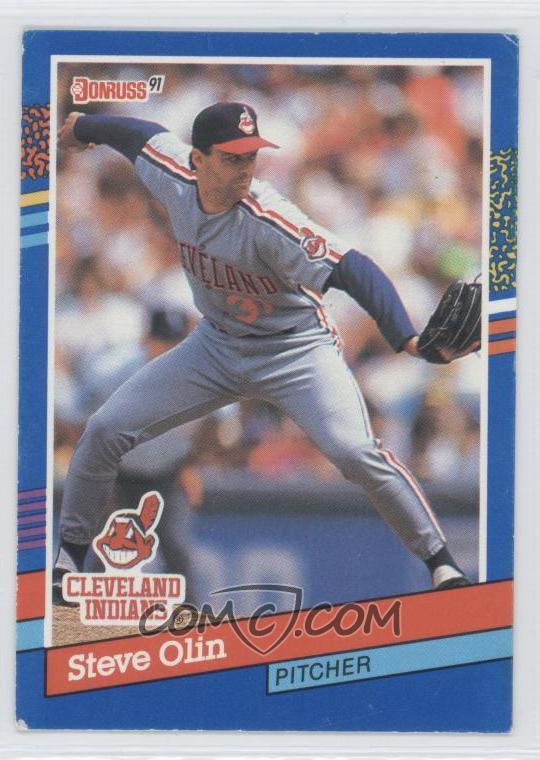
I remember the March day in 1993 when tragedy made me turn to my collection of baseball cards. I had hundreds of cards then, maybe thousands; a couple of years earlier, I'd even been given my first complete set as, I believe, an Easter present. It was a Donruss set that even included a "Rated Rookie" card of top prospect Mo Vaughn. I'd spent countless hours sorting through those cards, reading the notes on the back, trying to memorize the stats, organizing the cards into binder sheets by team.
On that March day, though, I went back into my binder and removed two cards and set them aside: This card and this card. And set aside they remained -- and remain, to this day. I have a little pile of cards in a drawer in my parents' house with Ken Griffey Jr. cards and Frank Thomas cards and Randy Johnson cards and Ivan Rodriguez cards and Mike Piazza cards and even an Edgar Martinez or two.
Steve Olin and Tim Crews, killed in a boating accident in Florida on March 22, 1993, remain in a place of honor atop that little pile.
I was not quite 10 years old then. It was my first baseball tragedy.
As countless others already have written, the death of a young athlete is a tragedy that hits home more than other tragedies do, more than they probably should. The death of a 22-year-old pitcher in California, after all, really shouldn't hit us any harder than the death of a 22-year-old college student or a 22-year-old soldier serving his country in Iraq.
But there's something about baseball, about sports that represents everything we cherish about youth, about potential, about life. We love athletes like Nick Adenhart because they can throw a low-90s fastball and a devastating changeup; we mourn people like Nick Adenhart because we know they have families, friends and people everywhere who feel empty without them.
"He was a privilege to be around. He grew as much in four years as anyone I've ever known," Angels manager Mike Scioscia said. "I can't tell you how proud I was of the great progress he made. He had arm surgery before throwing his first pitch in professional ball, so his family should be very proud."
Steve Olin was 27 when he died. Tim Crews was 31.
Olin was the Cleveland Indians' star closer; he'd saved 29 games in 1992 to go along with a 2.34 ERA. Crews was a newly signed free agent coming off a rough season in Los Angeles in which he'd compiled a 4.19 ERA in 78 innings pitched.
The numbers, though, really don't matter -- just like they don't really matter for Adenhart. All that matters was that they were people who brought a little happiness into the lives of thousands of other people.
Adenhart, in fact, had thrown six shutout innings on Wednesday night, striking out five. The Angles lost by a 6-4 score through no fault of Adenhart; when he left the game, he left with a 3-0 lead. More than 43,000 people were at Angel Stadium of Anaheim -- meaning Adenhart touched more than 43,000 lives (as well as countless more on television or even through fantasy baseball statistics) just hours before a drunk driver took him from us before dawn on Thursday.
Somewhere in that crowd, I'll bet there was a little kid who's not quite 10 years old who went home and threw a tennis ball against his bedroom wall because he wanted to pitch someday like the righty he'd just watched flummox the A's. Somewhere somewhere else, I'll bet there's a little kid who's not quite 10 years old who owns a couple of Nick Adenhart cards (maybe this one) and who pulled them aside to put them in a place of honor alongside his Evan Longorias and Dustin Pedroias and Tim Lincecums.
We'll all move on. We've dealt with death before. We'll be sad for a little while and we'll observe our moments of silence, and then we'll move on. We have to. We always do.
But some of those kids haven't had to deal with death before. Nick Adenhart hits closer to home than anything they've ever experienced.
I never forgot Tim Crews and Steve Olin.
Those kids will never forget Nick Adenhart.
On that March day, though, I went back into my binder and removed two cards and set them aside: This card and this card. And set aside they remained -- and remain, to this day. I have a little pile of cards in a drawer in my parents' house with Ken Griffey Jr. cards and Frank Thomas cards and Randy Johnson cards and Ivan Rodriguez cards and Mike Piazza cards and even an Edgar Martinez or two.
Steve Olin and Tim Crews, killed in a boating accident in Florida on March 22, 1993, remain in a place of honor atop that little pile.
I was not quite 10 years old then. It was my first baseball tragedy.
As countless others already have written, the death of a young athlete is a tragedy that hits home more than other tragedies do, more than they probably should. The death of a 22-year-old pitcher in California, after all, really shouldn't hit us any harder than the death of a 22-year-old college student or a 22-year-old soldier serving his country in Iraq.
But there's something about baseball, about sports that represents everything we cherish about youth, about potential, about life. We love athletes like Nick Adenhart because they can throw a low-90s fastball and a devastating changeup; we mourn people like Nick Adenhart because we know they have families, friends and people everywhere who feel empty without them.
"He was a privilege to be around. He grew as much in four years as anyone I've ever known," Angels manager Mike Scioscia said. "I can't tell you how proud I was of the great progress he made. He had arm surgery before throwing his first pitch in professional ball, so his family should be very proud."
Steve Olin was 27 when he died. Tim Crews was 31.
Olin was the Cleveland Indians' star closer; he'd saved 29 games in 1992 to go along with a 2.34 ERA. Crews was a newly signed free agent coming off a rough season in Los Angeles in which he'd compiled a 4.19 ERA in 78 innings pitched.
The numbers, though, really don't matter -- just like they don't really matter for Adenhart. All that matters was that they were people who brought a little happiness into the lives of thousands of other people.
Adenhart, in fact, had thrown six shutout innings on Wednesday night, striking out five. The Angles lost by a 6-4 score through no fault of Adenhart; when he left the game, he left with a 3-0 lead. More than 43,000 people were at Angel Stadium of Anaheim -- meaning Adenhart touched more than 43,000 lives (as well as countless more on television or even through fantasy baseball statistics) just hours before a drunk driver took him from us before dawn on Thursday.
Somewhere in that crowd, I'll bet there was a little kid who's not quite 10 years old who went home and threw a tennis ball against his bedroom wall because he wanted to pitch someday like the righty he'd just watched flummox the A's. Somewhere somewhere else, I'll bet there's a little kid who's not quite 10 years old who owns a couple of Nick Adenhart cards (maybe this one) and who pulled them aside to put them in a place of honor alongside his Evan Longorias and Dustin Pedroias and Tim Lincecums.
We'll all move on. We've dealt with death before. We'll be sad for a little while and we'll observe our moments of silence, and then we'll move on. We have to. We always do.
But some of those kids haven't had to deal with death before. Nick Adenhart hits closer to home than anything they've ever experienced.
I never forgot Tim Crews and Steve Olin.
Those kids will never forget Nick Adenhart.
Thursday, April 9, 2009
Joyce home run detours Dice-K
Daisuke Matsuzaka announced this spring his intention to throw more strikes, to be more economical with his pitch count and thus to take the Red Sox deeper into games.
Even after an outing Thursday in which he'd lasted just 5 1/3 innings but still thrown 100 pitches, he maintained his intention to pitch the way the Red Sox wanted him to pitch.
"Even while I was in Japan, I wanted to go deep to help our bullpen, and right now, not being able to go deep is stressful both for myself and the team," he said through an interpreter.
He wasn't that far off, though, from executing his game plan. The first inning actually went swimmingly -- he struck out Akinori Iwamura on four pitches to start the inning, and he struck out Willy Aybar on four pitches to end it. In between, the only time he even went to a three-ball count (the Matsuzaka special) was when he walked Carlos Pena on six pitches.
He looked like he was right on track when he opened the second, too. With outfielder Matt Joyce at the plate, he threw a fastball on the outside corner, a changeup just off the outside corner and a slider on the inside corner to work the count to 1-2.
With his next pitch, though, his fastball caught just a little too much of the plate -- and Joyce deposited it into the first row of seats behind the bullpen.
After that, things started to unravel a little bit. He missed twice to Gabe Gross before inducing a ground ball to second, and he went to a 3-1 count on Shawn Riggans before getting a ground ball to third.
And to start off the fourth, he walked Iwamura on four pitches. Two batters later -- Matsuzaka went to a 2-0 count on Carl Crawford before striking him out -- Evan Longoria hit a hanging slider over the Green Monster.
From then on, it was tough to worry about being economical. It was enough to worry about getting outs.
"There were nine hits, three walks -- that's a lot of baserunners," manager Terry Francona said. "Sometimes, when there's baserunners, you start pitching toward the game, also, and not giving in. Maybe sometimes one thing can lead to the other."
A pitcher has to have confidence to attack the strike zone. Matsuzaka looked like he was pitching with confidence to start the game -- but it's tough to keep that confidence when you see your best fastball blasted into the right-field seats.
Even after an outing Thursday in which he'd lasted just 5 1/3 innings but still thrown 100 pitches, he maintained his intention to pitch the way the Red Sox wanted him to pitch.
"Even while I was in Japan, I wanted to go deep to help our bullpen, and right now, not being able to go deep is stressful both for myself and the team," he said through an interpreter.
He wasn't that far off, though, from executing his game plan. The first inning actually went swimmingly -- he struck out Akinori Iwamura on four pitches to start the inning, and he struck out Willy Aybar on four pitches to end it. In between, the only time he even went to a three-ball count (the Matsuzaka special) was when he walked Carlos Pena on six pitches.
He looked like he was right on track when he opened the second, too. With outfielder Matt Joyce at the plate, he threw a fastball on the outside corner, a changeup just off the outside corner and a slider on the inside corner to work the count to 1-2.
With his next pitch, though, his fastball caught just a little too much of the plate -- and Joyce deposited it into the first row of seats behind the bullpen.
After that, things started to unravel a little bit. He missed twice to Gabe Gross before inducing a ground ball to second, and he went to a 3-1 count on Shawn Riggans before getting a ground ball to third.
And to start off the fourth, he walked Iwamura on four pitches. Two batters later -- Matsuzaka went to a 2-0 count on Carl Crawford before striking him out -- Evan Longoria hit a hanging slider over the Green Monster.
From then on, it was tough to worry about being economical. It was enough to worry about getting outs.
"There were nine hits, three walks -- that's a lot of baserunners," manager Terry Francona said. "Sometimes, when there's baserunners, you start pitching toward the game, also, and not giving in. Maybe sometimes one thing can lead to the other."
A pitcher has to have confidence to attack the strike zone. Matsuzaka looked like he was pitching with confidence to start the game -- but it's tough to keep that confidence when you see your best fastball blasted into the right-field seats.
Francona feeling out use of bullpen
"It's not the situation we really want to use anybody, but it was nice to get them in, get them out and let them get their feet under them."
-- Terry Francona, late Wednesday night
Yes, it's Game 2 of a 162-game season. No, you don't want to start screwing around with your bullpen this early, particularly with Daisuke Matsuzaka pitching today and a six-game West Coast swing on the schedule after that.
But it sure seemed like the Red Sox manager threw in the towel early last night. It sure seemed like he wasn't too worried about who was pitching against whom after Carlos Pena's two-run home run pushed the Rays' lead to 5-1. It sure seemed like he was using his pitching staff on Wednesday the way he's been using it for the last six weeks in Fort Myers.
Manny Delcarmen pitched the sixth inning. Ramon Ramirez pitched the seventh. Takashi Saito pitched the eighth. Javier Lopez pitched the ninth. What that meant, though, was that when Lopez (a lefty specialist) ran into trouble against a lineup featuring as many righties as lefties, there was no one to bail him out of trouble. Francona had gone through all his arms. No one was warming in the bullpen. No matter what, Lopez was finishing the ninth inning. It was as if Lopez was throwing a mop-up inning even though the Red Sox had gotten the tying run to the plate the previous half-inning.
"The bullpen came out of it with everybody just throwing one inning, so we're OK there."
-- Francona, late Wednesday night
Conversely, Joe Maddon managed the game less to get his guys work and more to win the game. He had Dan Wheeler throw one inning, yanked J.P. Howell when the situation called for it and then had Grant Balfour throw 1 1/3 innings to finish off the game.
Let's look back at the bottom of the eighth and the top of the ninth, the two innings (other than the top of the fifth, when the Rays got to Jon Lester) that could have decided the game.
The bottom of the eighth
Maddon brought in Howell to start the eighth inning; Dustin Pedroia was leading off, but lefty slugger David Ortiz was on deck. Of course, because these things never go according to script, Pedroia struck out and Ortiz roped a single to left field. Kevin Youkilis, a righty bat, then drilled a line drive down the third-base line that would have been a double.
Rocco Baldelli was on deck; the righthanded hitter is a .276 career hitter against righties and .296 career hitter against lefties. Grant Balfour, a righty, was in the bullpen. But the Red Sox had J.D. Drew available to pinch-hit; he's a .291 career hitter against righties (as opposed to .260 against lefties). On top of that, Balfour actually is tougher against lefties (.212) than righties (.224) in his career. Maddon left Howell in the game. Baldelli struck out.
Jason Bay, a righty with almost identical numbers against lefties and righties, came up next. He smoked a double into the left-field corner. Mike Lowell, a righty with similarly consistent numbers against pitchers of either "handedness," as Baldelli would say, was next; he was hit by a pitch.
That brought up switch-hitter Jed Lowrie with the bases loaded and two outs. In a 6-2 game, Lowrie was the tying run -- and in his short big-league career, he's hit .223 against righties and .338 against lefties. It was almost a no-brainer. Maddon went and got Balfour. Lowrie struck out.
The top of the ninth
No Red Sox pitcher has splits as drastic as Lopez. Lefties hit .182 against him last season; righties hit over .300. He's a lefty specialist. Except in garbage time or emergencies, he really shouldn't be pitching against righties.
Francona brought him in to start the ninth inning. His first assignment was switch-hitter Ben Zobrist, a player with similar numbers from both sides of the plate. Zobrist, hitting righty, flew out. But the next hitter was righty Gabe Kapler -- and Kapler doubled off the left-field wall.
Lefty Akinori Iwamura was next, and the result was predictable; he got under a slider and popped it up. It was bad luck that the pop-up eluded Jacoby Ellsbury and Jed Lowrie in shallow center field -- and that bad luck actually turned into good luck when Ellsbury threw Kapler out at third.
Righty Jason Bartlett was due up after Iwamura; here still was a runner on second and now two outs. Bartlett is a career .276 hitter -- .255 against righthanded pitchers and .328 against lefthanded pitcher. This seemed like a situation that screamed for a righty.
Francona, though, had no one warming. It was Lopez's show.
Bartlett proceeded to rip a single to left field to score a run to push the Rays' lead to 7-2.
Maybe it doesn't matter. It was, after all, the ninth inning. The Red Sox weren't all that likely to score four runs in the bottom half of the inning.
Then again, though, they'd loaded the bases in the bottom of the eighth and had come one hit away from making it a game again. With Jason Varitek (or a pinch-hitter), Jacoby Ellsbury and Pedroia due to hit, there was no reason the Red Sox couldn't have gotten a couple of runners on base in front of Ortiz and Youkilis.
"For the first couple of weeks, what we really want to do is not overuse and not underuse, hopefully, anybody. I think we feel pretty comfortable that we can pretty much go to anybody depending on what the situation is: how early, who's up, who's coming up, things like that. It gives us a few different options. The biggest thing is trying to be consistent with the usage of guys, especially in the first couple of weeks."
-- Francona, early Thursday morning
It's early. We all get that.
But in a division as tight as the American League East, every game counts. Four runs is not an insurmountable lead. Last night, though, Francona appeared to value the "not overuse and not underuse" mantra over keeping the game within striking distance. It'll be interesting to see how long that lasts.
-- Terry Francona, late Wednesday night
Yes, it's Game 2 of a 162-game season. No, you don't want to start screwing around with your bullpen this early, particularly with Daisuke Matsuzaka pitching today and a six-game West Coast swing on the schedule after that.
But it sure seemed like the Red Sox manager threw in the towel early last night. It sure seemed like he wasn't too worried about who was pitching against whom after Carlos Pena's two-run home run pushed the Rays' lead to 5-1. It sure seemed like he was using his pitching staff on Wednesday the way he's been using it for the last six weeks in Fort Myers.
Manny Delcarmen pitched the sixth inning. Ramon Ramirez pitched the seventh. Takashi Saito pitched the eighth. Javier Lopez pitched the ninth. What that meant, though, was that when Lopez (a lefty specialist) ran into trouble against a lineup featuring as many righties as lefties, there was no one to bail him out of trouble. Francona had gone through all his arms. No one was warming in the bullpen. No matter what, Lopez was finishing the ninth inning. It was as if Lopez was throwing a mop-up inning even though the Red Sox had gotten the tying run to the plate the previous half-inning.
"The bullpen came out of it with everybody just throwing one inning, so we're OK there."
-- Francona, late Wednesday night
Conversely, Joe Maddon managed the game less to get his guys work and more to win the game. He had Dan Wheeler throw one inning, yanked J.P. Howell when the situation called for it and then had Grant Balfour throw 1 1/3 innings to finish off the game.
Let's look back at the bottom of the eighth and the top of the ninth, the two innings (other than the top of the fifth, when the Rays got to Jon Lester) that could have decided the game.
The bottom of the eighth
Maddon brought in Howell to start the eighth inning; Dustin Pedroia was leading off, but lefty slugger David Ortiz was on deck. Of course, because these things never go according to script, Pedroia struck out and Ortiz roped a single to left field. Kevin Youkilis, a righty bat, then drilled a line drive down the third-base line that would have been a double.
Rocco Baldelli was on deck; the righthanded hitter is a .276 career hitter against righties and .296 career hitter against lefties. Grant Balfour, a righty, was in the bullpen. But the Red Sox had J.D. Drew available to pinch-hit; he's a .291 career hitter against righties (as opposed to .260 against lefties). On top of that, Balfour actually is tougher against lefties (.212) than righties (.224) in his career. Maddon left Howell in the game. Baldelli struck out.
Jason Bay, a righty with almost identical numbers against lefties and righties, came up next. He smoked a double into the left-field corner. Mike Lowell, a righty with similarly consistent numbers against pitchers of either "handedness," as Baldelli would say, was next; he was hit by a pitch.
That brought up switch-hitter Jed Lowrie with the bases loaded and two outs. In a 6-2 game, Lowrie was the tying run -- and in his short big-league career, he's hit .223 against righties and .338 against lefties. It was almost a no-brainer. Maddon went and got Balfour. Lowrie struck out.
The top of the ninth
No Red Sox pitcher has splits as drastic as Lopez. Lefties hit .182 against him last season; righties hit over .300. He's a lefty specialist. Except in garbage time or emergencies, he really shouldn't be pitching against righties.
Francona brought him in to start the ninth inning. His first assignment was switch-hitter Ben Zobrist, a player with similar numbers from both sides of the plate. Zobrist, hitting righty, flew out. But the next hitter was righty Gabe Kapler -- and Kapler doubled off the left-field wall.
Lefty Akinori Iwamura was next, and the result was predictable; he got under a slider and popped it up. It was bad luck that the pop-up eluded Jacoby Ellsbury and Jed Lowrie in shallow center field -- and that bad luck actually turned into good luck when Ellsbury threw Kapler out at third.
Righty Jason Bartlett was due up after Iwamura; here still was a runner on second and now two outs. Bartlett is a career .276 hitter -- .255 against righthanded pitchers and .328 against lefthanded pitcher. This seemed like a situation that screamed for a righty.
Francona, though, had no one warming. It was Lopez's show.
Bartlett proceeded to rip a single to left field to score a run to push the Rays' lead to 7-2.
Maybe it doesn't matter. It was, after all, the ninth inning. The Red Sox weren't all that likely to score four runs in the bottom half of the inning.
Then again, though, they'd loaded the bases in the bottom of the eighth and had come one hit away from making it a game again. With Jason Varitek (or a pinch-hitter), Jacoby Ellsbury and Pedroia due to hit, there was no reason the Red Sox couldn't have gotten a couple of runners on base in front of Ortiz and Youkilis.
"For the first couple of weeks, what we really want to do is not overuse and not underuse, hopefully, anybody. I think we feel pretty comfortable that we can pretty much go to anybody depending on what the situation is: how early, who's up, who's coming up, things like that. It gives us a few different options. The biggest thing is trying to be consistent with the usage of guys, especially in the first couple of weeks."
-- Francona, early Thursday morning
It's early. We all get that.
But in a division as tight as the American League East, every game counts. Four runs is not an insurmountable lead. Last night, though, Francona appeared to value the "not overuse and not underuse" mantra over keeping the game within striking distance. It'll be interesting to see how long that lasts.
Asked and answered: Jason Varitek
Red Sox starter Jon Lester pitched five strong innings and threw one bad pitch on Wednesday night; the lefty was charged with five earned runs, but a pop-up behind third that fell for a hit and a miscommunication on a squeeze bunt really were what ruined his night. Only his five-pitch walk to Gabe Kapler and the fastball he left up to Carlos Pena (a pitch Pena hit into the center-field bleachers) were really his fault.
The outing certain didn't diminish the faith Jason Varitek has in his young pitcher:
What went wrong for Jon in the fifth?
"We had some little things happen. Actually, he kept us in it -- he was one pitch away, the pitch to Pena that ended up being a little bit of the difference. ... A few freak things happened, and then he worked his way into keeping the game at a two-run game. He didn't get away with one pitch to Pena, and it ended up being a four-run game."
How tough a play is that squeeze?
"I took two hard steps (toward the ball), and it looked like Jonny had a bead on it and I went back to get home, but with those two hard steps, I got Jonny thinking I was getting it. We got criss-crossed there. I probably should have kept going through the play and got the out."
How did Jon look otherwise?
"I think Jon threw the ball well. He kept the damage -- there was some freak stuff in that inning -- kept it right there. We were just one pitch (away). Jon is going to do a great job for us, period. It's just unfornate that happened. He threw the ball well."
Is Jon's changeup where you want it to be at this point?
"He's going to progressively continue to get better with it. He made some good pitches with it tonight."
The outing certain didn't diminish the faith Jason Varitek has in his young pitcher:
What went wrong for Jon in the fifth?
"We had some little things happen. Actually, he kept us in it -- he was one pitch away, the pitch to Pena that ended up being a little bit of the difference. ... A few freak things happened, and then he worked his way into keeping the game at a two-run game. He didn't get away with one pitch to Pena, and it ended up being a four-run game."
How tough a play is that squeeze?
"I took two hard steps (toward the ball), and it looked like Jonny had a bead on it and I went back to get home, but with those two hard steps, I got Jonny thinking I was getting it. We got criss-crossed there. I probably should have kept going through the play and got the out."
How did Jon look otherwise?
"I think Jon threw the ball well. He kept the damage -- there was some freak stuff in that inning -- kept it right there. We were just one pitch (away). Jon is going to do a great job for us, period. It's just unfornate that happened. He threw the ball well."
Is Jon's changeup where you want it to be at this point?
"He's going to progressively continue to get better with it. He made some good pitches with it tonight."
Wednesday, April 8, 2009
Ramirez sets down the lefties
Terry Francona didn't exactly give Ramon Ramirez favorable circumstances when he summoned him from the Fenway Park bullpen for the first time. Ramirez is far, far better against righties than lefties -- righties have hit .198 off him in his career, while lefties hit .283 -- and Francona called on him to face Akinori Iwamura (lefty), Jason Bartlett (righty) and Carl Crawford (lefty).
Predictably, Ramirez looked sensational against Bartlett and serviceable against the other two. Iwamura flied to center and Crawford flied to right; Bartlett, on the other hand, looked silly swinging at a 94-mile-an-hour fastball at his eyes.
(Here's the dilemma: Do we make it sound more dramatic by pointing out that he struck out the Most Valuable Player of the American League champions, or do we make it sound less dramatic by pointing out that Bartlett isn't, at all, in any way, a good hitter?)
***
Jason Varitek sure is hitting the ball hard tonight, isn't he?
***
Give Bob Davidson points for consistency. If the pitch doesn't hit the dirt, he's not going to call it low. It's like he gets bonus points sfor degree of difficulty. (As in: It's more difficult to call a strike if it isn't really a strike.)
Jed Lowrie just struck out on a pitch below his knees -- just like Jason Bay did in the sixth and just like David Ortiz did in the third. At a certain point, the Red Sox have to make that adjustment, don't they?
Predictably, Ramirez looked sensational against Bartlett and serviceable against the other two. Iwamura flied to center and Crawford flied to right; Bartlett, on the other hand, looked silly swinging at a 94-mile-an-hour fastball at his eyes.
(Here's the dilemma: Do we make it sound more dramatic by pointing out that he struck out the Most Valuable Player of the American League champions, or do we make it sound less dramatic by pointing out that Bartlett isn't, at all, in any way, a good hitter?)
***
Jason Varitek sure is hitting the ball hard tonight, isn't he?
***
Give Bob Davidson points for consistency. If the pitch doesn't hit the dirt, he's not going to call it low. It's like he gets bonus points sfor degree of difficulty. (As in: It's more difficult to call a strike if it isn't really a strike.)
Jed Lowrie just struck out on a pitch below his knees -- just like Jason Bay did in the sixth and just like David Ortiz did in the third. At a certain point, the Red Sox have to make that adjustment, don't they?
Lester knocked around in first start
Jon Lester is done after five innings and 94 pitches. He pitched great through four innings but came apart in the fifth, surrendering a walk, a single, a bunt single, a bloop single behind third base and a two-run home run to dead center field.
Lester had walked nine hitters in his last nine spring training innings; he walked two in his five innings, but his control actually looked pretty good early. His curveball in particularly was nasty; he struck out Dioner Navarro (looking) and Ben Zobrist (swinging) on curveballs in pretty much the same spot (over the plate and right at the knees) in the second inning. He then fanned Carlos Pena on a great fastball up and in.
A walk issued to Gabe Kapler, though, burned him in the top of the fifth. Akinori Iwamura (who had the benefit of a quick 2-0 count) slapped a perfect hit-and-run single to left field, and Jason Bartlett then laid down a squeeze bunt that scored Kapler.
Lester caught a bad break when Carl Crawford's pop fly to shallow left field eluded both Jed Lowrie and Jason Bay along the foul line.
But it wasn't a bad break when, after Evan Longoria hit into a double play, the previously hitless-on-the-season Carlos Pena hit a Bernie Carbo shot on a pitch left up in the zone where he could extend his arms and go after it. (The mistake is particularly egregious given that umpire Bob Davidson has shown an inexplicable eagerness to call strikes on pitches down and away.)
Check back for an update after Lester meets with the media.
Lester had walked nine hitters in his last nine spring training innings; he walked two in his five innings, but his control actually looked pretty good early. His curveball in particularly was nasty; he struck out Dioner Navarro (looking) and Ben Zobrist (swinging) on curveballs in pretty much the same spot (over the plate and right at the knees) in the second inning. He then fanned Carlos Pena on a great fastball up and in.
A walk issued to Gabe Kapler, though, burned him in the top of the fifth. Akinori Iwamura (who had the benefit of a quick 2-0 count) slapped a perfect hit-and-run single to left field, and Jason Bartlett then laid down a squeeze bunt that scored Kapler.
Lester caught a bad break when Carl Crawford's pop fly to shallow left field eluded both Jed Lowrie and Jason Bay along the foul line.
But it wasn't a bad break when, after Evan Longoria hit into a double play, the previously hitless-on-the-season Carlos Pena hit a Bernie Carbo shot on a pitch left up in the zone where he could extend his arms and go after it. (The mistake is particularly egregious given that umpire Bob Davidson has shown an inexplicable eagerness to call strikes on pitches down and away.)
Check back for an update after Lester meets with the media.
Awards not to strive for
The three-pronged trophy for Red Sox Most Valuable Player was resting in the chair of second baseman Dustin Pedroia this afternoon, one chair over from where Tony Conigliaro Award winner Rocco Baldelli was getting ready for his first big-league start.
On the table in the middle of the room, though, was a trophy that so far appeared to have gone unclaimed: The Bringing Sexy Back Award, a silver-plated muscleman wearing nothing but a bronze Speedo. The inscription read, "Red Sox player most likely to find innuendo even if it's not there: Welcome Home Dinner 2009."
Baldelli claimed not to know who had won that particular award.
"That means it's up for grabs," one reporter said. "Could be you!"
"I'm not going for that one," Baldelli said wryly.
On the table in the middle of the room, though, was a trophy that so far appeared to have gone unclaimed: The Bringing Sexy Back Award, a silver-plated muscleman wearing nothing but a bronze Speedo. The inscription read, "Red Sox player most likely to find innuendo even if it's not there: Welcome Home Dinner 2009."
Baldelli claimed not to know who had won that particular award.
"That means it's up for grabs," one reporter said. "Could be you!"
"I'm not going for that one," Baldelli said wryly.
The Top 100 Red Sox: No. 8
With a night game scheduled, why not check back with the Top 100 list this morning?
10. Smoky Joe Wood, P
9. Babe Ruth, P
8. Tris Speaker, CF
More than a few things had to come together for Tris Speaker to become the greatest center fielder in Red Sox history. For one thing, he had to end up in center field -- and to do that, he first had to run into a dead end as a pitcher. His manager in Celburne, Texas, took care of that when he decided to teach his young lefty a lesson and leave him in a game in which he gave up 22 runs.
But the Red Sox still had to find him and keep him. Red Sox scout George Huff wasn't first in line; the St. Louis Browns and Pittsburgh Pirates both had a crack at him and passed. But even when Huff offered $750 for Speaker's contract, the player's mother intervened: "I've never been so insulted in my life. I will not have my boy sold around like a slave for so many dollars."
Even then, after a brief appearance in Boston in 1907, Speaker was completely forgotten by Red Sox ownership and not mailed a contract. Only because he couldn't get a tryout anywhere else -- "I'm sorry, kid, I've already got more players in camp than I know what to do with," wrote Giants manager John McGraw -- did he return to the Red Sox.
If not for his unique determination and his confidence in his abilities, he might have hung it up right then and there. (Here's one example of his determination: He broke his right arm and his collarbone when he was thrown from a horse as a child. To keep playing, he taught himself to throw and hit lefthanded.)
Still the Red Sox didn't have use for him; they loaned him to Little Rock's minor league team in lieu of rent for the use of their ballpark. Only when Speaker emerged as the best player in the Southern Association that year did the Red Sox pay back the rent on the ballpark and reacquire Speaker.
Good thing. They wouldn't have won the 1912 World Series (against McGraw's Giants) without him.
The "Gray Eagle" -- so named in part because of his hair lost its color early -- had a sensational regular season in 1912, hitting .383 with a a league-leading 53 doubles and 12 home runs to go along with 90 RBI and 136 runs scored. His .383 batting average set a franchise record that wouldn't be broken until Ted Williams hit .406 in 1941; no Red Sox player other than Williams has even come within 10 points of .383.
He also played the best defensive center field anyone had ever seen. Said one writer, "Speaker has been credited with revolutioning outfield play, but that is less than true. The word 'revolution' suggests followers, and few outfielders were capable of following Speaker's pattern."
But never did his confidence show itself the way it did in Game 8 of the World Series. He came to the plate in the bottom of the 10th inning with runners on first and second and the Giants ahead by a 2-1 score. Christy Mathewson jammed him with a pitch and induced a foul pop-up -- Mathewson (and Speaker, too, some witnesses have suggested) called for catcher Chief Meyers to make the catch even though first baseman Fred Merkle had a better chance at the ball. It dropped to the ground.
"You just called for the wrong man, Matty," Speaker yelled at the pitcher. "It's going to cost you the ballgame."
Speaker delivered, driving a single to right field to score the tying run. After Mathewson walked Duffy Lewis, Larry Gardner hit a sacrifice fly to score the winning run from third.
Coming up: A pitcher who had 195 career wins before he put on a Red Sox uniform and won No. 300 in Boston.
10. Smoky Joe Wood, P
9. Babe Ruth, P
8. Tris Speaker, CF
More than a few things had to come together for Tris Speaker to become the greatest center fielder in Red Sox history. For one thing, he had to end up in center field -- and to do that, he first had to run into a dead end as a pitcher. His manager in Celburne, Texas, took care of that when he decided to teach his young lefty a lesson and leave him in a game in which he gave up 22 runs.
But the Red Sox still had to find him and keep him. Red Sox scout George Huff wasn't first in line; the St. Louis Browns and Pittsburgh Pirates both had a crack at him and passed. But even when Huff offered $750 for Speaker's contract, the player's mother intervened: "I've never been so insulted in my life. I will not have my boy sold around like a slave for so many dollars."
Even then, after a brief appearance in Boston in 1907, Speaker was completely forgotten by Red Sox ownership and not mailed a contract. Only because he couldn't get a tryout anywhere else -- "I'm sorry, kid, I've already got more players in camp than I know what to do with," wrote Giants manager John McGraw -- did he return to the Red Sox.
If not for his unique determination and his confidence in his abilities, he might have hung it up right then and there. (Here's one example of his determination: He broke his right arm and his collarbone when he was thrown from a horse as a child. To keep playing, he taught himself to throw and hit lefthanded.)
Still the Red Sox didn't have use for him; they loaned him to Little Rock's minor league team in lieu of rent for the use of their ballpark. Only when Speaker emerged as the best player in the Southern Association that year did the Red Sox pay back the rent on the ballpark and reacquire Speaker.
Good thing. They wouldn't have won the 1912 World Series (against McGraw's Giants) without him.
The "Gray Eagle" -- so named in part because of his hair lost its color early -- had a sensational regular season in 1912, hitting .383 with a a league-leading 53 doubles and 12 home runs to go along with 90 RBI and 136 runs scored. His .383 batting average set a franchise record that wouldn't be broken until Ted Williams hit .406 in 1941; no Red Sox player other than Williams has even come within 10 points of .383.
He also played the best defensive center field anyone had ever seen. Said one writer, "Speaker has been credited with revolutioning outfield play, but that is less than true. The word 'revolution' suggests followers, and few outfielders were capable of following Speaker's pattern."
But never did his confidence show itself the way it did in Game 8 of the World Series. He came to the plate in the bottom of the 10th inning with runners on first and second and the Giants ahead by a 2-1 score. Christy Mathewson jammed him with a pitch and induced a foul pop-up -- Mathewson (and Speaker, too, some witnesses have suggested) called for catcher Chief Meyers to make the catch even though first baseman Fred Merkle had a better chance at the ball. It dropped to the ground.
"You just called for the wrong man, Matty," Speaker yelled at the pitcher. "It's going to cost you the ballgame."
Speaker delivered, driving a single to right field to score the tying run. After Mathewson walked Duffy Lewis, Larry Gardner hit a sacrifice fly to score the winning run from third.
Coming up: A pitcher who had 195 career wins before he put on a Red Sox uniform and won No. 300 in Boston.
How long until we panic about Okajima?
One-third of an inning. One walk. One hit batsman. Two earned runs. That's how Hideki Okajima opened the season.
Is it too early to panic?
It's probably too early.
Okajima, after all, didn't even allow a hit. If Justin Masterson hadn't allowed a single to Evan Longoria, we wouldn't be having this conversation. His ERA would be 0.00.
But Masterson did give up that single. Those two runs did score. Okajima's ERA is, in fact, 54.00 after Tuesday's win over the Rays on Opening Day.
And that means we have to start wondering what we didn't let ourselves wonder last season or this spring: Is Okajima the weak link in this Red Sox bullpen?
Opponents hit just .212 off Okajima last season. But the way that number broke down gives us plenty of cause for concern:
* With the bases empty: .174
* With runners on base: .269
* With runners in scoring position: .300
Here's some context in the form of Manny Delcarmen:
* With the bases empty: .200
* With runners on base: .211
* With runners in scoring position: .239
And Javier Lopez:
* With the bases empty: .236
* With runners on base: .255
* With runners in scoring position: .200
And Jonathan Papelbon:
* With the bases empty: .188
* With runners on base: .280
* With the runners in scoring position: .231
And Ramon Ramirez (with the Royals):
* With the bases empty: .224
* With runners on base: .220
* With runners in scoring position: .192
In stark contrast to the other three, Okajima's numbers were like an exponential curve. As the situation got worse, so too did his pitching. Opponents looked helpless against Okajima when there was no one on base. When there were runners on base, though, they looked pretty decent -- and when there were runners in scoring position, they looked like All-Stars.
Here's the point: All of this has to make you wonder how much confidence Terry Francona is going to be be able to have in his 33-year-old lefty. Okajima already has demonstrated he has trouble pitching in the middle of an inning with men on base -- the situation when, you know, relievers tend to be most necessary. It's not encouraging that Okajima came into Tuesday's game at the start of an inning, with no one on base, and still left with a pair of earned runs to his name.
The Red Sox bullpen is incredibly deep. Papelbon, Delcarmen, Lopez, Ramirez, Justin Masterson and Takashi Saito all look like they're going to fit perfectly into their roles in the bullpen. Saito, Delcarmen and Masterson will pitch in the seventh and the eighth innings; Lopez and Ramirez will pitch against lefties and righties, respectively, in big spots. Papelbon, of course, will close.
But the shaky outing delivered by Okajima on Tuesday give us reason to worry that there isn't a spot in which he really can be used. Can he be used to get out of a jam? Probably not. Can he be used at the start of an inning? At this point, the jury is still out.
***
On the bright side: How about Josh Beckett? How about Kevin Youkilis? How about Jason Bay? How about Dustin Pedroia? How about the fact that eight of nine hitters had at least one hit and six of nine had either a run scored or an RBI? How about the fact that the Red Sox sent James Shields back to Tampa with an 8.44 ERA?
How about: It's baseball season!
Is it too early to panic?
It's probably too early.
Okajima, after all, didn't even allow a hit. If Justin Masterson hadn't allowed a single to Evan Longoria, we wouldn't be having this conversation. His ERA would be 0.00.
But Masterson did give up that single. Those two runs did score. Okajima's ERA is, in fact, 54.00 after Tuesday's win over the Rays on Opening Day.
And that means we have to start wondering what we didn't let ourselves wonder last season or this spring: Is Okajima the weak link in this Red Sox bullpen?
Opponents hit just .212 off Okajima last season. But the way that number broke down gives us plenty of cause for concern:
* With the bases empty: .174
* With runners on base: .269
* With runners in scoring position: .300
Here's some context in the form of Manny Delcarmen:
* With the bases empty: .200
* With runners on base: .211
* With runners in scoring position: .239
And Javier Lopez:
* With the bases empty: .236
* With runners on base: .255
* With runners in scoring position: .200
And Jonathan Papelbon:
* With the bases empty: .188
* With runners on base: .280
* With the runners in scoring position: .231
And Ramon Ramirez (with the Royals):
* With the bases empty: .224
* With runners on base: .220
* With runners in scoring position: .192
In stark contrast to the other three, Okajima's numbers were like an exponential curve. As the situation got worse, so too did his pitching. Opponents looked helpless against Okajima when there was no one on base. When there were runners on base, though, they looked pretty decent -- and when there were runners in scoring position, they looked like All-Stars.
Here's the point: All of this has to make you wonder how much confidence Terry Francona is going to be be able to have in his 33-year-old lefty. Okajima already has demonstrated he has trouble pitching in the middle of an inning with men on base -- the situation when, you know, relievers tend to be most necessary. It's not encouraging that Okajima came into Tuesday's game at the start of an inning, with no one on base, and still left with a pair of earned runs to his name.
The Red Sox bullpen is incredibly deep. Papelbon, Delcarmen, Lopez, Ramirez, Justin Masterson and Takashi Saito all look like they're going to fit perfectly into their roles in the bullpen. Saito, Delcarmen and Masterson will pitch in the seventh and the eighth innings; Lopez and Ramirez will pitch against lefties and righties, respectively, in big spots. Papelbon, of course, will close.
But the shaky outing delivered by Okajima on Tuesday give us reason to worry that there isn't a spot in which he really can be used. Can he be used to get out of a jam? Probably not. Can he be used at the start of an inning? At this point, the jury is still out.
***
On the bright side: How about Josh Beckett? How about Kevin Youkilis? How about Jason Bay? How about Dustin Pedroia? How about the fact that eight of nine hitters had at least one hit and six of nine had either a run scored or an RBI? How about the fact that the Red Sox sent James Shields back to Tampa with an 8.44 ERA?
How about: It's baseball season!
Tuesday, April 7, 2009
How the Red Sox can beat James Shields
Like Josh Beckett, Tampa Bay starter James Shields has pitched better in April than in any other month of his career. In 11 starts in March or April, "Early Season Game" James has a 2.88 ERA and has seen opponents hit .220 off him.
A year ago, he was utterly masterful in five of his first six starts before May 1 -- including a two-hit shutout of the Red Sox on April 27. Even before that, though, his ERA was just 2.70; h'd thrown six shutout innings against Baltimore at home and pitched seven strong innings against the Orioles at Camden Yards (on Opening Day) as well as at home against Toronto later in the month.
The Red Sox, though, have experience beating him. A week after Shields tossed that complete-game shutout at Tropicana Field, the Red Sox jumped all over him in the first inning and cruised to a 12-4 victory.
What was the difference between the two games?
Command on the mound and patience at the plate.
In Shields' first outing against the Red Sox, leadoff hitter Jacoby Ellsbury got into a quick 0-2 hole and eventually struck out looking. In the second inning, Shields got two strikes on all three batters he faced and retired all three on a pop-up and two slow groundouts.
The Red Sox made an adjustment in the fourth inning; Ellsbury and J.D. Drew each went after the first pitch, and Dustin Pedroia took a strike and a ball before hitting a fly ball to right field. They couldn't wait to get themselves into a hole -- and that meant they started swinging at pitches at which they didn't want to swing.
"By throwing them strikes, it would make them swing early, which is what they don't want to do," Rays manager Joe Maddon said after the game. "They want to work the count. So you've got to be aggressive early, and that's a big part of his game, getting ahead with his fastball and working the cutter and change off of that. He did a great job with that. I can't say enough. That was outstanding."
A week later, though, the Red Sox pounced. Part of the reason was a command that was less sharp; part of the reason was that the Red Sox weren't waiting around and letting themselves get backed into a corner at the plate.
"It's not the easiest thing to face a team back-to-back," Red Sox manager Terry Francona said after the game. "Sometimes their stuff's not the same, their command's not the same. There are different reasons."
Shields had gotten a two-strike count on five of the first six hitters he'd faced on April 27. On May 3, he didn't get a two-strike count on anyone until a run already was across the plate. He then had to face Manny Ramirez and did well to keep the ball down, but Ramirez's ground ball got back up the middle to score two more runs.
He ran into trouble again in the second. He went to a 3-1 count on Ellsbury before walking him, and after a wild pitch put Ellsbury on second, he left a cutter too far up and Pedroia stroked a line drive to right field to give the Red Sox their fourth run of the game.
It brings us to a little bit of an obvious conclusion: When Shields pitched with command, he threw strikes and got ahead in the count and forced the Red Sox to protect the zone. When he didn't pitch with command, he gave the Red Sox a chance to be selective.
That'll be interesting to watch from the first batter in the bottom of the first inning. Ellsbury said this spring that he needs to be ready to pounce on pitches in the strike zone and not just let pitchers get ahead in the count. A year ago, the center fielder hit just .180 with two strikes -- including .175 with the count full, which means the count never really ended up in his favor no matter how selective he was.
On the other hand, he hit .347 when swinging at the first pitch, .341 when swinging at a 1-0 pitch and .375 when swinging at a 2-0 pitch.
That's a microcosm of what the Red Sox must do against Shields. The Rays' ace is going to want to get ahead in the count in the first couple of innings and use that to his advantage for the rest of the game; the Red Sox are going to have to be aggressive early and patient late to get some runs on the board and get him out of the game early.
A year ago, he was utterly masterful in five of his first six starts before May 1 -- including a two-hit shutout of the Red Sox on April 27. Even before that, though, his ERA was just 2.70; h'd thrown six shutout innings against Baltimore at home and pitched seven strong innings against the Orioles at Camden Yards (on Opening Day) as well as at home against Toronto later in the month.
The Red Sox, though, have experience beating him. A week after Shields tossed that complete-game shutout at Tropicana Field, the Red Sox jumped all over him in the first inning and cruised to a 12-4 victory.
What was the difference between the two games?
Command on the mound and patience at the plate.
In Shields' first outing against the Red Sox, leadoff hitter Jacoby Ellsbury got into a quick 0-2 hole and eventually struck out looking. In the second inning, Shields got two strikes on all three batters he faced and retired all three on a pop-up and two slow groundouts.
The Red Sox made an adjustment in the fourth inning; Ellsbury and J.D. Drew each went after the first pitch, and Dustin Pedroia took a strike and a ball before hitting a fly ball to right field. They couldn't wait to get themselves into a hole -- and that meant they started swinging at pitches at which they didn't want to swing.
"By throwing them strikes, it would make them swing early, which is what they don't want to do," Rays manager Joe Maddon said after the game. "They want to work the count. So you've got to be aggressive early, and that's a big part of his game, getting ahead with his fastball and working the cutter and change off of that. He did a great job with that. I can't say enough. That was outstanding."
A week later, though, the Red Sox pounced. Part of the reason was a command that was less sharp; part of the reason was that the Red Sox weren't waiting around and letting themselves get backed into a corner at the plate.
"It's not the easiest thing to face a team back-to-back," Red Sox manager Terry Francona said after the game. "Sometimes their stuff's not the same, their command's not the same. There are different reasons."
Shields had gotten a two-strike count on five of the first six hitters he'd faced on April 27. On May 3, he didn't get a two-strike count on anyone until a run already was across the plate. He then had to face Manny Ramirez and did well to keep the ball down, but Ramirez's ground ball got back up the middle to score two more runs.
He ran into trouble again in the second. He went to a 3-1 count on Ellsbury before walking him, and after a wild pitch put Ellsbury on second, he left a cutter too far up and Pedroia stroked a line drive to right field to give the Red Sox their fourth run of the game.
It brings us to a little bit of an obvious conclusion: When Shields pitched with command, he threw strikes and got ahead in the count and forced the Red Sox to protect the zone. When he didn't pitch with command, he gave the Red Sox a chance to be selective.
That'll be interesting to watch from the first batter in the bottom of the first inning. Ellsbury said this spring that he needs to be ready to pounce on pitches in the strike zone and not just let pitchers get ahead in the count. A year ago, the center fielder hit just .180 with two strikes -- including .175 with the count full, which means the count never really ended up in his favor no matter how selective he was.
On the other hand, he hit .347 when swinging at the first pitch, .341 when swinging at a 1-0 pitch and .375 when swinging at a 2-0 pitch.
That's a microcosm of what the Red Sox must do against Shields. The Rays' ace is going to want to get ahead in the count in the first couple of innings and use that to his advantage for the rest of the game; the Red Sox are going to have to be aggressive early and patient late to get some runs on the board and get him out of the game early.
Monday, April 6, 2009
Josh Beckett's first start of the season
There's a chance Josh Beckett might not have a great start against Tampa Bay tomorrow. It's Opening Day. It happens.
Brandon Webb surrendered six earned runs in four innings today. Cliff Lee gave up seven earned runs in five innings. CC Sabathia saw the Orioles score six runs against him as he failed to survive the fifth inning.
Even John Lannan gave up six runs in three innings!
(Wait, that might not fit here. Never mind.)
Check out these pitching lines:
* 4 2/3 IP, 5 ER, 4 BB, 6 K
* 5 IP, 1 ER, 4 BB, 5 K
* 7 IP, 1 ER, 1 BB, 5 K
* 6 IP, 0 ER, 3 BB, 6 K
* 7 IP, 1 ER, 3 BB, 9 K
What you've just seen are Josh Beckett's last five season-opening starts -- in order from most recent to least recent.
Last year's rough outing might not surprise you; Beckett had a 4.67 ERA on May 18 and a 4.34 ERA as late as Aug. 17. He just never showed the same form he'd shown as he dominated the playoffs the previous year.
But look at the second line -- sure, he only gave up one earned run, but he walked four hitters and threw 94 pitches despite being liefted in the sixth. It was effective, but it sure wasn't ace-like.
Over his next four outings, though, he walked just three total hitters -- and struck out 23. Not coincidentally, he went 4-0 with a 2.60 ERA. He finished that season with 20 wins and a 3.27 ERA and torched the Angels, Indians and Rockies en route to a World Series ring.
We can't know now what Beckett will do against the Rays on Tuesday. But whether he throws a two-hit shutout or gets shelled, we still won't know what it bodes for the coming season.
Brandon Webb surrendered six earned runs in four innings today. Cliff Lee gave up seven earned runs in five innings. CC Sabathia saw the Orioles score six runs against him as he failed to survive the fifth inning.
Even John Lannan gave up six runs in three innings!
(Wait, that might not fit here. Never mind.)
Check out these pitching lines:
* 4 2/3 IP, 5 ER, 4 BB, 6 K
* 5 IP, 1 ER, 4 BB, 5 K
* 7 IP, 1 ER, 1 BB, 5 K
* 6 IP, 0 ER, 3 BB, 6 K
* 7 IP, 1 ER, 3 BB, 9 K
What you've just seen are Josh Beckett's last five season-opening starts -- in order from most recent to least recent.
Last year's rough outing might not surprise you; Beckett had a 4.67 ERA on May 18 and a 4.34 ERA as late as Aug. 17. He just never showed the same form he'd shown as he dominated the playoffs the previous year.
But look at the second line -- sure, he only gave up one earned run, but he walked four hitters and threw 94 pitches despite being liefted in the sixth. It was effective, but it sure wasn't ace-like.
Over his next four outings, though, he walked just three total hitters -- and struck out 23. Not coincidentally, he went 4-0 with a 2.60 ERA. He finished that season with 20 wins and a 3.27 ERA and torched the Angels, Indians and Rockies en route to a World Series ring.
We can't know now what Beckett will do against the Rays on Tuesday. But whether he throws a two-hit shutout or gets shelled, we still won't know what it bodes for the coming season.
The Top 100 Red Sox: No. 9
We'll fill in the Top 10 as we go:
10. Smoky Joe Wood, P
9. Babe Ruth
"He was such a rube that he got more of his share of teasing, some of it not too pleasant. 'The Big Baboon, some of them used to call him behind his back, and then a few got up enough nerve to ridicule him to his face. This started to get under his skin, and when they didn't let up, he finally challenged the whole ballclub. Nobody was so dumb as to take him up on it, so that put an end to that."
-- Harry Hooper, "The Glory of Their Times"
Babe Ruth liked to eat. Babe Ruth liked to drink. Babe Ruth liked to hit a baseball. Everyone knows that.
What's less known is how much Babe Ruth liked to fight.
He liked to fight on the field -- after a walk to the first hitter of a game against Washington, he got himself into an argument with the home-plate umpire and ended up throwing a punch. (Ernie Shore took over in relief and retired 26 in a row; Ruth was suspended for nine games.)
He liked to fight on the train -- during the 1918 World Series, he was punching out the top of straw hats on the team train when he scuffled with someone and wound up with a swollen finger that almost cost the Red Sox a win in Game 4.
He liked to fight in the ring -- after the 1918 season, during a contract dispute, he threatened to retire from baseball and become a boxer.
And he liked to fight in the clubhouse -- after his manager hired a hotel porter to catch him breaking curfew, he stormed into the locker room the next day and shouted, "If you ever come to my room again, you son of a bitch, I'll punch you right in the nose!"
But it was that personality that made him such a great pitcher. In four years with the Red Sox, Ruth compiled a 2.19 ERA and an ERA+ of 125; in 1916, he had a 1.75 ERA and threw nine complete-game shutouts and went the distance in a 2-1 win in 14 innings in Game 2 of the World Series. His ERA ranks fifth in franchise history, and so too does his winning percentage of .659.
Oh, and he could hit a little bit, too. Let's hear from Hooper again:
"Sometimes I still can't believe what I saw: This 19-year-old kid, crude, poorly educated, only lightly brushed by the social veneer we call civilization, gradually transformed into the idol of American youth and the symbol of baseball the world over -- a man loved by more peopleand with an intensity of feeling that perhaps has never been equaled before or since. I saw a man transformed from a human being into something pretty close to a god. If somebody had predicted that back on the Boston Red Sox in 1914, he would have been thrown in an insane asylum."
Coming up: The greatest center fielder in Red Sox history.
10. Smoky Joe Wood, P
9. Babe Ruth
"He was such a rube that he got more of his share of teasing, some of it not too pleasant. 'The Big Baboon, some of them used to call him behind his back, and then a few got up enough nerve to ridicule him to his face. This started to get under his skin, and when they didn't let up, he finally challenged the whole ballclub. Nobody was so dumb as to take him up on it, so that put an end to that."
-- Harry Hooper, "The Glory of Their Times"
Babe Ruth liked to eat. Babe Ruth liked to drink. Babe Ruth liked to hit a baseball. Everyone knows that.
What's less known is how much Babe Ruth liked to fight.
He liked to fight on the field -- after a walk to the first hitter of a game against Washington, he got himself into an argument with the home-plate umpire and ended up throwing a punch. (Ernie Shore took over in relief and retired 26 in a row; Ruth was suspended for nine games.)
He liked to fight on the train -- during the 1918 World Series, he was punching out the top of straw hats on the team train when he scuffled with someone and wound up with a swollen finger that almost cost the Red Sox a win in Game 4.
He liked to fight in the ring -- after the 1918 season, during a contract dispute, he threatened to retire from baseball and become a boxer.
And he liked to fight in the clubhouse -- after his manager hired a hotel porter to catch him breaking curfew, he stormed into the locker room the next day and shouted, "If you ever come to my room again, you son of a bitch, I'll punch you right in the nose!"
But it was that personality that made him such a great pitcher. In four years with the Red Sox, Ruth compiled a 2.19 ERA and an ERA+ of 125; in 1916, he had a 1.75 ERA and threw nine complete-game shutouts and went the distance in a 2-1 win in 14 innings in Game 2 of the World Series. His ERA ranks fifth in franchise history, and so too does his winning percentage of .659.
Oh, and he could hit a little bit, too. Let's hear from Hooper again:
"Sometimes I still can't believe what I saw: This 19-year-old kid, crude, poorly educated, only lightly brushed by the social veneer we call civilization, gradually transformed into the idol of American youth and the symbol of baseball the world over -- a man loved by more peopleand with an intensity of feeling that perhaps has never been equaled before or since. I saw a man transformed from a human being into something pretty close to a god. If somebody had predicted that back on the Boston Red Sox in 1914, he would have been thrown in an insane asylum."
Coming up: The greatest center fielder in Red Sox history.
Sunday, April 5, 2009
The Top 100 Red Sox: No. 10
Your faithful scribe will be at Fenway Park bright and early Monday morning for Opening Day. But while the Braves and Phillies are opening the season in Philadelphia, why not check back in with the Top 100 list?
Here's where we last left things:
20. Dwight Evans, RF
19. Bobby Doerr, 2B
18. Mel Parnell, P
17. Luis Tiant, P
16. Joe Cronin, SS
15. Jim Rice, LF
14. Carlton Fisk, C
13. Wade Boggs, 3B
12. David Ortiz, DH
11. Carl Yastrzemski, LF
If Yaz doesn't make the final 10, you might ask, who does? Let's find out:
10. Smoky Joe Wood
If there was a Cy Young Award in 1912, it probably would have gone to Walter Johnson. "The Big Train" won 33 games, second in the American League, but he led all pitchers in ERA (1.39), strikeouts (303), WHIP (o.908) and adjusted ERA+ (242).
Joe Wood would have finished second in the voting thanks to his 34 wins and his second-place finish in each of those categories: A 1.91 ERA, 258 strikeouts, a 1.014 WHIP and an adjusted ERA+ of 172.
But when the two met in September in perhaps the most anticipated game of the pre-World War II era, it was Wood who came out on top. Clark Griffith, the Washington Senators' owner, even called Wood out in the papers: "We will consider him a coward if he doesn't pitch against Johnson." So many fans wanted to watch the two aces pitch against each other that they were permitted to line up along the Fenway Park infield, pressed up almost against the foul lines.
"I never saw so many people in one place in my life," Wood said later.
The two pitchers matched zeroes through five innings before the Red Sox broke through in the sixth; Tris Speaker doubled into the crowd with two outs, and Duffy Lewis followed with a pop fly to right field to score Speaker with the game's first run.
As it turned out, it would be the game's only run. Wood allowed the Senators to load the bases in the third inning but got out of the jam with a strikeout; he ran into trouble in the sixth, eighth and ninth, too, but emerged unscathed. He needed 119 pitches -- including 20 in a ninth inning in which he allowed a runner to reach second base with just one out -- but didn't relinquish the lead Lewis and Speaker had given him.
Wood's sensational 1912 season should have been just the first in a long line of sensational seasons. But he sprained his ankle in March of 1913 and hurt his shoulder trying to compensate for his sore ankle; he followed that up by breaking his thumb in a rundown in July. the maladies limited him to just 18 starts in 1913 and 14 starts in 1914.
He launched a comeback in 1915, going 15-5 with a 1.49 ERA -- he even outdueled Chicago ace Red Faber in a key mid-July series on the road. But he was all but done at that point; he balked at a salary before the 1916 season and ended up skipping the entire season. He never won another game in the major leagues.
Coming up: A man who hit 49 home runs in a Red Sox uniform.
Here's where we last left things:
20. Dwight Evans, RF
19. Bobby Doerr, 2B
18. Mel Parnell, P
17. Luis Tiant, P
16. Joe Cronin, SS
15. Jim Rice, LF
14. Carlton Fisk, C
13. Wade Boggs, 3B
12. David Ortiz, DH
11. Carl Yastrzemski, LF
If Yaz doesn't make the final 10, you might ask, who does? Let's find out:
10. Smoky Joe Wood
If there was a Cy Young Award in 1912, it probably would have gone to Walter Johnson. "The Big Train" won 33 games, second in the American League, but he led all pitchers in ERA (1.39), strikeouts (303), WHIP (o.908) and adjusted ERA+ (242).
Joe Wood would have finished second in the voting thanks to his 34 wins and his second-place finish in each of those categories: A 1.91 ERA, 258 strikeouts, a 1.014 WHIP and an adjusted ERA+ of 172.
But when the two met in September in perhaps the most anticipated game of the pre-World War II era, it was Wood who came out on top. Clark Griffith, the Washington Senators' owner, even called Wood out in the papers: "We will consider him a coward if he doesn't pitch against Johnson." So many fans wanted to watch the two aces pitch against each other that they were permitted to line up along the Fenway Park infield, pressed up almost against the foul lines.
"I never saw so many people in one place in my life," Wood said later.
The two pitchers matched zeroes through five innings before the Red Sox broke through in the sixth; Tris Speaker doubled into the crowd with two outs, and Duffy Lewis followed with a pop fly to right field to score Speaker with the game's first run.
As it turned out, it would be the game's only run. Wood allowed the Senators to load the bases in the third inning but got out of the jam with a strikeout; he ran into trouble in the sixth, eighth and ninth, too, but emerged unscathed. He needed 119 pitches -- including 20 in a ninth inning in which he allowed a runner to reach second base with just one out -- but didn't relinquish the lead Lewis and Speaker had given him.
Wood's sensational 1912 season should have been just the first in a long line of sensational seasons. But he sprained his ankle in March of 1913 and hurt his shoulder trying to compensate for his sore ankle; he followed that up by breaking his thumb in a rundown in July. the maladies limited him to just 18 starts in 1913 and 14 starts in 1914.
He launched a comeback in 1915, going 15-5 with a 1.49 ERA -- he even outdueled Chicago ace Red Faber in a key mid-July series on the road. But he was all but done at that point; he balked at a salary before the 1916 season and ended up skipping the entire season. He never won another game in the major leagues.
Coming up: A man who hit 49 home runs in a Red Sox uniform.
What I want to see this season
The Spring Training That Wouldn't End finally, mercifully, will come to an end this weekend; the Braves and Phillies open the season on Sunday night, and the Red Sox tangle with the defending league champion Rays on Monday afternoon at Fenway Park.
Are you as excited as I am?
Here's what I want to see this season:
* I want to see Clay Buchholz in the major leagues by Memorial Day.
There's no problem with sending the 24-year-old to Triple-A Pawtucket. This isn't last season's Twins, wasting Francisco Liriano by giving his starts to Livan Hernandez. This is the Red Sox; Brad Penny started the All-Star Game just a couple of years ago. There's tons of depth here.
But at the same time, Buchholz is a guy the Red Sox refused to trade in the offseason; it's getting close to the time when we're all going to have to see what he can do. And if he's not up in the major leagues by Memorial Day, John Smoltz is going to be healthy and in line for a spot in the rotation. What, other than injury, is going to put Buchholz in line for a spot?
* I want to see tempered expectations for Mike Lowell and David Ortiz.
They're old. Let's face facts. They're old. Lowell turned 35 in the offseason; Ortiz turned 33. And even though Lowell is saying all the right things about how great he feels and Ortiz has hit three home runs in 13 spring-training games, there's no telling how they're going to perform once the season begins.
Fans and writers keep referencing 2007. That was the season in which Lowell hit .324 with 120 RBI; that was the season in which Ortiz hit .332 with 35 home runs and 117 RBI.
A year ago, neither guy really came close to those numbers. Lowell hit 17 home runs with 73 RBI; Ortiz hit 23 home runs with 89 RBI. That seems like about what we should expect from those two this season; anything else would be a bonus.
* I want to see J.D. Drew hit in the top half of the lineup.
He's hit 30 home runs just once in his career. Heck, he's hit 20 home runs just three times. He's driven in 100 runs just once.
Still, though, everyone wants J.D. Drew to be what Jason Bay is, to be a home-run hitter. J.D. Drew isn't a home-run hitter. J.D. Drew is an on-base machine. The guy has OBP'ed .390 or better in four of the last five seasons; he hits .280 and knows how to draw a walk. He's a guy you want on the bases in front of Bay and Ortiz, not a guy you want hitting behind them.
* I want to see what Jason Bay can do.
Speaking of Bay: Through six seasons, he has a better batting average (.282 to .281), on-base percentage (.375 to .348) and slugging percentage (.516 to .498) than Justin Morneau. He has fewer at-bats per home run (18.7 to 20.2). Down the stretch last season, even Bay went .293/.370/.527 -- and he was even better in the playoffs.
Still, though, it doesn't seem like Red Sox fans are falling all over themselves to see what Bay can do with a full season. They should be.
* I want to see Jon Lester stay healthy.
Two hundred and thirty-seven innings last year. Five years, $30 million in his new contract. Something tells me John Henry wants to see Jon Lester stay healthy, too.
* I want to see Daniel Bard tear Triple-A apart.
The 23-year-old flamethrower had a 1.99 ERA in 49 2/3 innings at Double-A Portland and didn't allow a run in 9 2/3 innings with the Red Sox in spring training. Some fans already are anointing him the successor to Jonathan Papelbon. The first step, though, is a dominant season at Triple-A -- and maybe a late-summer call-up, a la Justin Masterson last season.
* I want to see the Red Sox explore a trade for Miguel Cabrera -- the most natural successor to Ortiz -- in July.
There's no reason for the Red Sox to empty out their farm system for an unproven catcher like Jarrod Saltalamacchia. But if the Tigers fall out of contention by midseason, Theo Epstein is going to have to see what it would take to land Miguel Cabrera -- and if it takes trading Buchholz, he might have to do it.
Buchholz looks like a stud, sure. But Cabrera has four 30-homer seasons and five 100-RBI seasons under his belt and isn't yet 26 years old. His age-25 comparisons: Ken Griffey Jr., Hank Aaron, Orlando Cepeda, Frank Robinson, Mickey Mantle, Vladmir Guerrero, Al Kaline.
Sound good to you? Sounds good to me, too.
Cabrera has seven years and $150 million left on a contract extension he signed a year ago. Considering how much the Red Sox were willing to pay Mark Teixeira, it doesn't seem like a price tag from which they'd shy away. If the Tigers decide they can't afford that type of contract -- they do, after all, play in Detroit -- the Red Sox ought to be all over them.
Are you as excited as I am?
Here's what I want to see this season:
* I want to see Clay Buchholz in the major leagues by Memorial Day.
There's no problem with sending the 24-year-old to Triple-A Pawtucket. This isn't last season's Twins, wasting Francisco Liriano by giving his starts to Livan Hernandez. This is the Red Sox; Brad Penny started the All-Star Game just a couple of years ago. There's tons of depth here.
But at the same time, Buchholz is a guy the Red Sox refused to trade in the offseason; it's getting close to the time when we're all going to have to see what he can do. And if he's not up in the major leagues by Memorial Day, John Smoltz is going to be healthy and in line for a spot in the rotation. What, other than injury, is going to put Buchholz in line for a spot?
* I want to see tempered expectations for Mike Lowell and David Ortiz.
They're old. Let's face facts. They're old. Lowell turned 35 in the offseason; Ortiz turned 33. And even though Lowell is saying all the right things about how great he feels and Ortiz has hit three home runs in 13 spring-training games, there's no telling how they're going to perform once the season begins.
Fans and writers keep referencing 2007. That was the season in which Lowell hit .324 with 120 RBI; that was the season in which Ortiz hit .332 with 35 home runs and 117 RBI.
A year ago, neither guy really came close to those numbers. Lowell hit 17 home runs with 73 RBI; Ortiz hit 23 home runs with 89 RBI. That seems like about what we should expect from those two this season; anything else would be a bonus.
* I want to see J.D. Drew hit in the top half of the lineup.
He's hit 30 home runs just once in his career. Heck, he's hit 20 home runs just three times. He's driven in 100 runs just once.
Still, though, everyone wants J.D. Drew to be what Jason Bay is, to be a home-run hitter. J.D. Drew isn't a home-run hitter. J.D. Drew is an on-base machine. The guy has OBP'ed .390 or better in four of the last five seasons; he hits .280 and knows how to draw a walk. He's a guy you want on the bases in front of Bay and Ortiz, not a guy you want hitting behind them.
* I want to see what Jason Bay can do.
Speaking of Bay: Through six seasons, he has a better batting average (.282 to .281), on-base percentage (.375 to .348) and slugging percentage (.516 to .498) than Justin Morneau. He has fewer at-bats per home run (18.7 to 20.2). Down the stretch last season, even Bay went .293/.370/.527 -- and he was even better in the playoffs.
Still, though, it doesn't seem like Red Sox fans are falling all over themselves to see what Bay can do with a full season. They should be.
* I want to see Jon Lester stay healthy.
Two hundred and thirty-seven innings last year. Five years, $30 million in his new contract. Something tells me John Henry wants to see Jon Lester stay healthy, too.
* I want to see Daniel Bard tear Triple-A apart.
The 23-year-old flamethrower had a 1.99 ERA in 49 2/3 innings at Double-A Portland and didn't allow a run in 9 2/3 innings with the Red Sox in spring training. Some fans already are anointing him the successor to Jonathan Papelbon. The first step, though, is a dominant season at Triple-A -- and maybe a late-summer call-up, a la Justin Masterson last season.
* I want to see the Red Sox explore a trade for Miguel Cabrera -- the most natural successor to Ortiz -- in July.
There's no reason for the Red Sox to empty out their farm system for an unproven catcher like Jarrod Saltalamacchia. But if the Tigers fall out of contention by midseason, Theo Epstein is going to have to see what it would take to land Miguel Cabrera -- and if it takes trading Buchholz, he might have to do it.
Buchholz looks like a stud, sure. But Cabrera has four 30-homer seasons and five 100-RBI seasons under his belt and isn't yet 26 years old. His age-25 comparisons: Ken Griffey Jr., Hank Aaron, Orlando Cepeda, Frank Robinson, Mickey Mantle, Vladmir Guerrero, Al Kaline.
Sound good to you? Sounds good to me, too.
Cabrera has seven years and $150 million left on a contract extension he signed a year ago. Considering how much the Red Sox were willing to pay Mark Teixeira, it doesn't seem like a price tag from which they'd shy away. If the Tigers decide they can't afford that type of contract -- they do, after all, play in Detroit -- the Red Sox ought to be all over them.
Saturday, April 4, 2009
A&A: Justin Masterson, pitcher
It's hard to believe that Justin Masterson still is awaiting his first Opening Day with the Red Sox. A year ago, the sinkerballer began the season as a starting pitcher with Double-A Portland; this year, he's an integral part of perhaps the deepest bullpen in the major leagues.
A year ago, he went 4-3 with a 3.67 ERA as a starting pitcher but dropped his ERA to 2.36 as a reliever; in the playoffs, he allowed two earned runs in 9 2/3 innings.
What have you learned from being around a pitching staff as talented and experienced as this one?
"Nothing jumps out at you; it's not like a life-changing experience or anything. But you see how each guy goes about their business differently. They know what makes them good, and they stick to that. It gives you a chance to see how they do it and take some things away from that and really figure out who you are as a pitcher also."
When you come in for your first couple of springs, do you make a point to look around to see how someone like Josh Beckett handles himself?
"You notice it. There's an aspect of, you want to see what makes them good and how they're successful. But you also want to make sure you do your own thing, too. You have to remember that even though he does that, that doesn't mean it's going to work for me. You definitely, when you come in, you take a look. For me, it's better to have a broader knowledge of what's going on rather than saying, 'Well, this is how I do it.' You take it in. You take a look at everyone, whether it be a guy at the top or a guy at the bottom. You see what you might like or dislike, throw in your two cents' worth."
What did you see out of Beckett last year while he was struggling?
"He was doing the same stuff he was doing when it was working well. He stuck to his plan. Whether it be the body maybe not feeling as good as it had or some unfortunate circumstances as far as not catching breaks, he just let it. But what I saw was that he continued to stay on what he knew made him good. He didn’t veer from that. If something goes wrong, you can’t be like, ‘Oh, I’ve got to change everything!’ You’ve got to remember that this also made you good – so stick with it and things will turn back around."
Have you seen a difference in Jon Lester this spring after the year he had last year?
"There’s definitely a whole lot more confidence – not that it wasn’t there before, but when you have success, and he was definitely a workhorse for us last year, it builds in your mind. You say, ‘OK, I’ve been here and I know what I can do and what I want to do.’ He’s taken it upon himself to be more of that go-to guy."
Is there some excitement about how deep and talented this pitching staff is?
"Absolutely. You look down through, and even guys who are here today (jerks head toward the locker of Daniel Bard), guys who will be in Pawtucket and whatnot, guys who will be in Double-A and working their way up, there’s a lot of quality guys. It’s like, ‘Man, somewhere else, they might be in the big leagues right now.’ That’s a testament to the organization and how much quality pitching we have – on paper. Of course, the season hasn’t begun, so we don’t really know what’s really going to take place. Maybe it won’t work out as well as we hoped. That’s what makes it exciting."
Does that make it more fun to come to the ballpark, even just to sit in the bullpen and watch the starters pitch?
"What’s great about this team in general, besides the talent, is the quality of individuals who, all by themselves, they want to come and watch other guys pitch. They want to watch the game to see how well the starters are going to do, and you’re rooting for every other bullpen guy that’s going out. And that’s even before having such great talent, which makes it probably even more like, ‘Oh, man, there could be something special about what’s going on.’"
A year ago, he went 4-3 with a 3.67 ERA as a starting pitcher but dropped his ERA to 2.36 as a reliever; in the playoffs, he allowed two earned runs in 9 2/3 innings.
What have you learned from being around a pitching staff as talented and experienced as this one?
"Nothing jumps out at you; it's not like a life-changing experience or anything. But you see how each guy goes about their business differently. They know what makes them good, and they stick to that. It gives you a chance to see how they do it and take some things away from that and really figure out who you are as a pitcher also."
When you come in for your first couple of springs, do you make a point to look around to see how someone like Josh Beckett handles himself?
"You notice it. There's an aspect of, you want to see what makes them good and how they're successful. But you also want to make sure you do your own thing, too. You have to remember that even though he does that, that doesn't mean it's going to work for me. You definitely, when you come in, you take a look. For me, it's better to have a broader knowledge of what's going on rather than saying, 'Well, this is how I do it.' You take it in. You take a look at everyone, whether it be a guy at the top or a guy at the bottom. You see what you might like or dislike, throw in your two cents' worth."
What did you see out of Beckett last year while he was struggling?
"He was doing the same stuff he was doing when it was working well. He stuck to his plan. Whether it be the body maybe not feeling as good as it had or some unfortunate circumstances as far as not catching breaks, he just let it. But what I saw was that he continued to stay on what he knew made him good. He didn’t veer from that. If something goes wrong, you can’t be like, ‘Oh, I’ve got to change everything!’ You’ve got to remember that this also made you good – so stick with it and things will turn back around."
Have you seen a difference in Jon Lester this spring after the year he had last year?
"There’s definitely a whole lot more confidence – not that it wasn’t there before, but when you have success, and he was definitely a workhorse for us last year, it builds in your mind. You say, ‘OK, I’ve been here and I know what I can do and what I want to do.’ He’s taken it upon himself to be more of that go-to guy."
Is there some excitement about how deep and talented this pitching staff is?
"Absolutely. You look down through, and even guys who are here today (jerks head toward the locker of Daniel Bard), guys who will be in Pawtucket and whatnot, guys who will be in Double-A and working their way up, there’s a lot of quality guys. It’s like, ‘Man, somewhere else, they might be in the big leagues right now.’ That’s a testament to the organization and how much quality pitching we have – on paper. Of course, the season hasn’t begun, so we don’t really know what’s really going to take place. Maybe it won’t work out as well as we hoped. That’s what makes it exciting."
Does that make it more fun to come to the ballpark, even just to sit in the bullpen and watch the starters pitch?
"What’s great about this team in general, besides the talent, is the quality of individuals who, all by themselves, they want to come and watch other guys pitch. They want to watch the game to see how well the starters are going to do, and you’re rooting for every other bullpen guy that’s going out. And that’s even before having such great talent, which makes it probably even more like, ‘Oh, man, there could be something special about what’s going on.’"
Roster breakdown
The Red Sox will have to finalize their roster and make their last-minute moves on Sunday before the season begins; here's what to expect:
Starting pitchers (5): Josh Beckett, Jon Lester, Daisuke Matsuzaka, Brad Penny, Tim Wakefield.
Relief pitchers (7): Manny Delcarmen, Javier Lopez, Justin Masterson, Hideki Okajima, Jonathan Papelbon, Ramon Ramirez, Takashi Saito.
Catchers (2): George Kottaras, Jason Varitek.
Infielders (7): Chris Carter, Nick Green, Mike Lowell, Jed Lowrie, David Ortiz, Dustin Pedroia, Kevin Youkilis.
Outfielders (4): Rocco Baldelli, Jason Bay, J.D. Drew, Jacoby Ellsbury.
To the disabled list: Julio Lugo and Mark Kotsay both are likely to stay with the team through its West Coast road trip. After that, manager Terry Francona said, they'll probably head to Fort Myers (because it's warmer there than in Pawtucket) to begin their progression back to the active roster. John Smoltz also was placed on the disabled list; his target date is somewhere around June 1.
To Triple-A: Reliever Daniel Bard is leaving Citi Field for Pawtucket after the game; his goal, he said, is to make it in time to catch the second half of the North Carolina-Michigan State game. Starter Clay Buchholz officially was optioned to Triple-A on Saturday; he's well aware he's the next guy in line should the Red Sox need anyone. First baseman Jeff Bailey and journeyman outfielder Brad Wilkerson, who lost out to Chris Carter in the race for the final roster spot, likewise will head to Pawtucket.
To Double-A: Top prospect Lars Anderson will start the season with the Portland SeaDogs, but he won't necessarily stay there long if he hits the way he did a year ago. He hit .316 with a .436 on-base percentage and a .526 slugging percentage thanks to his 13 doubles and five home runs in 133 at-bats. Outfielder Josh Reddick, a free-swinging power hitter whose focus this year will be his patience at the plate, will join Anderson in Portland. Reliever Junichi Tazawa will begin the season in Portland as well, but if he's as sharp as he looked in spring training, the Red Sox might not leave him there.
Starting pitchers (5): Josh Beckett, Jon Lester, Daisuke Matsuzaka, Brad Penny, Tim Wakefield.
Relief pitchers (7): Manny Delcarmen, Javier Lopez, Justin Masterson, Hideki Okajima, Jonathan Papelbon, Ramon Ramirez, Takashi Saito.
Catchers (2): George Kottaras, Jason Varitek.
Infielders (7): Chris Carter, Nick Green, Mike Lowell, Jed Lowrie, David Ortiz, Dustin Pedroia, Kevin Youkilis.
Outfielders (4): Rocco Baldelli, Jason Bay, J.D. Drew, Jacoby Ellsbury.
To the disabled list: Julio Lugo and Mark Kotsay both are likely to stay with the team through its West Coast road trip. After that, manager Terry Francona said, they'll probably head to Fort Myers (because it's warmer there than in Pawtucket) to begin their progression back to the active roster. John Smoltz also was placed on the disabled list; his target date is somewhere around June 1.
To Triple-A: Reliever Daniel Bard is leaving Citi Field for Pawtucket after the game; his goal, he said, is to make it in time to catch the second half of the North Carolina-Michigan State game. Starter Clay Buchholz officially was optioned to Triple-A on Saturday; he's well aware he's the next guy in line should the Red Sox need anyone. First baseman Jeff Bailey and journeyman outfielder Brad Wilkerson, who lost out to Chris Carter in the race for the final roster spot, likewise will head to Pawtucket.
To Double-A: Top prospect Lars Anderson will start the season with the Portland SeaDogs, but he won't necessarily stay there long if he hits the way he did a year ago. He hit .316 with a .436 on-base percentage and a .526 slugging percentage thanks to his 13 doubles and five home runs in 133 at-bats. Outfielder Josh Reddick, a free-swinging power hitter whose focus this year will be his patience at the plate, will join Anderson in Portland. Reliever Junichi Tazawa will begin the season in Portland as well, but if he's as sharp as he looked in spring training, the Red Sox might not leave him there.
What are you, an owl?
MLB Network's Harold Reynolds was just leaving the visitors' clubhouse at Citi Field when Josh Beckett called out to him.
"Hey, Harold," Beckett said, his voice casual. "Have you talked to him yet?"
"To who?" Reynolds asked.
"What are you, an owl?"
Such is the life when there's a day game after a night game. Mark Kotsay, one of the few players in the locker room at 8:45 a.m., even said, "What, you guys think you're going to get someone to talk this early?"
Then again, guys find ways to get going. When Kevin Youkilis asked Chris Carter if he was going to grab a Red Bull to get himself going, Carter shot back, "I've already had two!"
But the owl joke -- the new fascination of Beckett and Brad Penny -- wasn't just a byproduct of the early hour.
"This is going to be their thing -- like all season," Kotsay said.
"Hey, Harold," Beckett said, his voice casual. "Have you talked to him yet?"
"To who?" Reynolds asked.
"What are you, an owl?"
Such is the life when there's a day game after a night game. Mark Kotsay, one of the few players in the locker room at 8:45 a.m., even said, "What, you guys think you're going to get someone to talk this early?"
Then again, guys find ways to get going. When Kevin Youkilis asked Chris Carter if he was going to grab a Red Bull to get himself going, Carter shot back, "I've already had two!"
But the owl joke -- the new fascination of Beckett and Brad Penny -- wasn't just a byproduct of the early hour.
"This is going to be their thing -- like all season," Kotsay said.
Friday, April 3, 2009
Command trouble again plagues Lester
Blame it on the long spring training. Blame it on the cold. Go all Milli Vanilli on us and blame it on the rain. Dismiss it entirely if you want. It is still spring training, after all.
But here are the numbers for Jon Lester in his last two starts: Nine innings pitched, nine walks.
"I really couldn't tell you what was going on," the lefthander said before departing Citi Field for the evening. "I really didn't have a feel for my body, for pitches. It was one of those nights, I guess, of battling myself from the beginning. The good thing is that it was an exhibition game. I could walk away from it and not worry about the results and it doesn't mean anything. In five days, we'll try to make an adjustment and do a little bit better."
Said manager Terry Francona, "I know he didn't command, but he still competes and doesn't give in. It looked like, from the very beginning, he was leaving some balls up on his arm side, and then he overcompensated a couple of times. I'm glad it was a spring-training game and not a regular-season game. ...
"That happens more than people realize during the course of a whole season."
It's important to take that with a grain of salt, given that it's in Francona's job description to downplay concerns about his players. In this case, though, he's not just blowing smoke. Bouts with command trouble do happen -- especially in the early going.
Josh Beckett walked four in 4 2/3 innings in his first start a year ago en route to five earned runs. Tim Wakefield walked five hitters twice in his first five starts. Daisuke Matsuzaka habitually walks five batters an inning. (OK, that's an exaggeration. But he did walk at least five hitters in eight of his 29 starts a year ago.)
And a year ago, Lester walked 15 hitters in his first 20 1/3 innings -- including five in 4 1/3 innings in his a rough start at Cleveland. Not surprisingly, those 20 1/3 innings netted him a pair of losses and a 5.31 ERA.
The rest of the way, though, the lanky lefty walked 51 hitters in 190 innings -- and he went 15-4 with a 2.98 ERA.
Lester walked 66 hitters in 210 1/3 regular-season innings a year ago; he then walked five hitters in 26 2/3 postseason innings. Before last Saturday, he had walked just two hitters in his first 10 2/3 spring innings -- though most of those innings, of course, came in short stints.
He also struck out eight in four innings in a minor-league game on March 14, a game in which he threw strikes on 39 of his 62 pitches. The next day, he officially signed a five-year, $30 million contract extension.
Since he signed that contract, though, his command appears to have deserted him. He dismissed his rough outing a week ago against the Phillies -- "I wasn't as wild as the walks said," he said. "I was around where I wanted to be, and some calls could have gone either way." -- and insisted everything still was on track.
But he's averaging a walk an inning in his last two starts and there's not much time left to make changes to his delivery. He's scheduled to start against Tampa Bay on April 8, just five days hence.
"We need to make some adjustments between now and then," he said. "But I think it's small adjustments, something that's minor and nothing that's too big of a deal. I'm not too worried about it. Once we get to Fenway and get that adrenaline going and get into that extra gear, everything will be fine."
But here are the numbers for Jon Lester in his last two starts: Nine innings pitched, nine walks.
"I really couldn't tell you what was going on," the lefthander said before departing Citi Field for the evening. "I really didn't have a feel for my body, for pitches. It was one of those nights, I guess, of battling myself from the beginning. The good thing is that it was an exhibition game. I could walk away from it and not worry about the results and it doesn't mean anything. In five days, we'll try to make an adjustment and do a little bit better."
Said manager Terry Francona, "I know he didn't command, but he still competes and doesn't give in. It looked like, from the very beginning, he was leaving some balls up on his arm side, and then he overcompensated a couple of times. I'm glad it was a spring-training game and not a regular-season game. ...
"That happens more than people realize during the course of a whole season."
It's important to take that with a grain of salt, given that it's in Francona's job description to downplay concerns about his players. In this case, though, he's not just blowing smoke. Bouts with command trouble do happen -- especially in the early going.
Josh Beckett walked four in 4 2/3 innings in his first start a year ago en route to five earned runs. Tim Wakefield walked five hitters twice in his first five starts. Daisuke Matsuzaka habitually walks five batters an inning. (OK, that's an exaggeration. But he did walk at least five hitters in eight of his 29 starts a year ago.)
And a year ago, Lester walked 15 hitters in his first 20 1/3 innings -- including five in 4 1/3 innings in his a rough start at Cleveland. Not surprisingly, those 20 1/3 innings netted him a pair of losses and a 5.31 ERA.
The rest of the way, though, the lanky lefty walked 51 hitters in 190 innings -- and he went 15-4 with a 2.98 ERA.
Lester walked 66 hitters in 210 1/3 regular-season innings a year ago; he then walked five hitters in 26 2/3 postseason innings. Before last Saturday, he had walked just two hitters in his first 10 2/3 spring innings -- though most of those innings, of course, came in short stints.
He also struck out eight in four innings in a minor-league game on March 14, a game in which he threw strikes on 39 of his 62 pitches. The next day, he officially signed a five-year, $30 million contract extension.
Since he signed that contract, though, his command appears to have deserted him. He dismissed his rough outing a week ago against the Phillies -- "I wasn't as wild as the walks said," he said. "I was around where I wanted to be, and some calls could have gone either way." -- and insisted everything still was on track.
But he's averaging a walk an inning in his last two starts and there's not much time left to make changes to his delivery. He's scheduled to start against Tampa Bay on April 8, just five days hence.
"We need to make some adjustments between now and then," he said. "But I think it's small adjustments, something that's minor and nothing that's too big of a deal. I'm not too worried about it. Once we get to Fenway and get that adrenaline going and get into that extra gear, everything will be fine."
Rain dampens Citi Field debut
The Red Sox didn't get much of a chance to wander around and explore Citi Field thanks to the rain that's fallen on and off all afternoon. Pitchers are out on the field stretching now, an hour and a half before the game; it's the first time all afternoon it's been dry enough to do anything.
That means players have been stuck in the locker room and players' lounge. The players' lounge, of course, is a friendlier spot because it's off-limits to reporters. In the locker room, though, plenty are spread out on chairs, playing cards or watching a random Pirates-Cubs game -- featuring Skinny Barry -- on MLB Network.
Between innings, the Fix-It scratch-remover product came onto the screen.
"I'm going to start scratching up my car just to fix it!" piped up Mike Lowell.
The park itself, though, is beautiful. The upper deck in right field hangs almost over the field; same with both upper decks in left field. The orange numbers on the left-field fence say it's 364 feet, but it looks far closer than that. There's nothing scenic behind the ballpark the way there is in Pittsburgh and San Francisco, but it's an awfully nice new stadium.
Pregame note: Kevin Youkilis is sick and will not play in today's game; newly anointed backup first baseman Chris Carter will take his place in the Red Sox lineup. Regulars are expected to play about five innings and get two or three at-bats. Starting pitcher Jon Lester should throw between 75 and 85 pitches.
Other pregame note: Brad Penny will throw in "kind of a camp game" on Tuesday in Fort Myers, his last outing before his scheduled season debut on April 12. If the Red Sox are rained out at all before that date, Penny would be pushed up to April 11, the fifth game of the season, and Josh Beckett's second start would be pushed back.
The question the press corps here can't figure out, though: What's Penny doing with the team in New York? The consensus is that he's just excited about participating in Opening Day festivities in Boston; he'll still have to fly out that night to get back to Fort Myers, but he'll at least get to be introduced with the rest of the active roster.
That means players have been stuck in the locker room and players' lounge. The players' lounge, of course, is a friendlier spot because it's off-limits to reporters. In the locker room, though, plenty are spread out on chairs, playing cards or watching a random Pirates-Cubs game -- featuring Skinny Barry -- on MLB Network.
Between innings, the Fix-It scratch-remover product came onto the screen.
"I'm going to start scratching up my car just to fix it!" piped up Mike Lowell.
The park itself, though, is beautiful. The upper deck in right field hangs almost over the field; same with both upper decks in left field. The orange numbers on the left-field fence say it's 364 feet, but it looks far closer than that. There's nothing scenic behind the ballpark the way there is in Pittsburgh and San Francisco, but it's an awfully nice new stadium.
Pregame note: Kevin Youkilis is sick and will not play in today's game; newly anointed backup first baseman Chris Carter will take his place in the Red Sox lineup. Regulars are expected to play about five innings and get two or three at-bats. Starting pitcher Jon Lester should throw between 75 and 85 pitches.
Other pregame note: Brad Penny will throw in "kind of a camp game" on Tuesday in Fort Myers, his last outing before his scheduled season debut on April 12. If the Red Sox are rained out at all before that date, Penny would be pushed up to April 11, the fifth game of the season, and Josh Beckett's second start would be pushed back.
The question the press corps here can't figure out, though: What's Penny doing with the team in New York? The consensus is that he's just excited about participating in Opening Day festivities in Boston; he'll still have to fly out that night to get back to Fort Myers, but he'll at least get to be introduced with the rest of the active roster.
The Top 100 Red Sox: 11-12
Retracing our steps like Hansel and Gretel:
22. Mo Vaughn, 1B
21. Nomar Garciaparra, SS
20. Dwight Evans, RF
19. Bobby Doerr, 2B
18. Mel Parnell, P
17. Luis Tiant, P
16. Joe Cronin, SS
15. Jim Rice, LF
14. Carlton Fisk, C
13. Wade Boggs, 3B
12. David Ortiz
We covered this a little bit in the Trot Nixon capsule, but isn't it incredible just how many franchise-changing home runs David Ortiz has hit in his career? The man has 12 career home runs in 63 postseason games -- including seven in 33 ALCS games -- and it seems like each one has done a little bit to change the trajectory of the Red Sox franchise.
And just because it's fun to do a countdown within a countdown, let's look back at the Most Memorable Home Runs in the Career of David Ortiz:
Honorable mention: Game 5, 2008 ALCS, 7th inning
He was 5-for-31 (.161) in the playoffs entering the game and 0-for-3 in the game when he came up with two runners on and the Red Sox trailing by a 7-1 score to the Rays. But with Coco Crisp on third and Dustin Pedroia on first, Ortiz tucked a home run just inside the right-field foul pole to pull the Red Sox within three runs and to make the incredible comeback, for the first time, seem realistic.
The Red Sox didn't go on to win the World Series. They didn't even go on to make it to the World Series. But that home run did two things:
* It pushed the ALCS to a sixth and, later, seventh game, and the Red Sox thus have been able to tell themselves all offseason they were a game away from the World Series; and
* It restored the luster that had been fading from Big Papi -- and provided a big shot in the arm for a guy who needed a big shot in the arm going into this offseason.
5. April 11, 2004, 12th inning
Sure, it was just early April. But the Red Sox had lost to the Yankees in such heartbreaking fashion the previous year that it felt like they'd missed their shot. With so many key players (including Pedro Martinez, Nomar Garciaparra and Jason Varitek) set to become free agents at the end of the year, the year already had something of a do-or-die feel to it.
A spark had to come from somewhere, and Ortiz -- a Minnesota castaway who had hit 31 home runs in 448 at-bats the year before -- was just the guy to provide it.
The Red Sox already had rallied with a run in the eighth and a run in the ninth to tie the game at 4 and send it to extra innings; second baseman Mark Bellhorn was right in the center of things, scoring one run and driving in another to keep the Red Sox in it. Ortiz, actually, had a chance to win the game in the bottom of the ninth but flew out to center field with Bellhorn in scoring position.
He didn't let that happen again. Bill Mueller drew a walk to lead off the bottom of the 12th, and Ortiz followed with a two-run home run over the Green Monster -- just his second walk-off home run as a member of the Red Sox.
4. Game 1, 2003 ALCS, 4th inning
It's hard to remember now, but the 2003 American League Championship Series had the pall of 1999 hanging all over it. In 1999, after all, the Red Sox had pulled out a dramatic five-game victory in the American League Division Series only to be rudely dismissed by the Yankees a round later. And in 2003, as the Red Sox again needed more than their share of dramatics to get to the ALCS, the Yankees again were waiting. Mike Mussina, who had gone 17-8 with a 3.40 ERA that season, was well-rested and scheduled to pitch against Tim Wakefield, who was pretty much the only option the Red Sox had.
But with Manny Ramirez on first base and no one out in the top of the fourth, Ortiz worked the count full and hit his first career postseason home run. That was the first time either team had scored in the game -- and that was the first time even the most cynical Red Sox fans began to think, "We can win this thing."
That feeling would last until the eighth inning of Game 7 -- and it would be what sparked everything the Red Sox did that offseason to prepare for 2004.
3. Game 3, 2004 ALDS, 9th inning
The prelude to the magic. The Red Sox already were virtually assured of a berth in the American League Championship Series; they'd knocked around Angels pitching for two days, and only a seventh-inning grand slam by Vladmir Guerrero had stalled the celebration.
But, still, the Red Sox had to close it out -- they knew as well as anyone else what could happen if you gave a quality team a second lift in a short playoff series. With two outs, Ortiz came to the plate to face lefty Jarrod Washburn, a starter brought on to replace the tiring Francisco Rodriguez.
Ortiz hit the first pitch Washburn threw over the Green Monster to end the series and send the Red Sox to New York to face the Yankees.
2. Game 5, 2004 ALCS, 8th inning
The Yankees led by a 4-2 score going into the top of the eighth inning; Mariano Rivera was warming in the bullpen. The Red Sox needed another miracle.
Ortiz couldn't hit a two-run home run; he was leading off the inning. But it didn't take long -- two pitches, in fact -- until he hit another big home run, his second in two nights, to pull the Red Sox within a run. From there, it was only a matter of time before the Red Sox scratched out another run on a walk, a single and a Jason Varitek sacrifice fly.
Ortiz then, of course, singled home Johnny Damon with the winning run in the 14th inning to send the series back to Yankee Stadium.
1. Game 4, 2004 ALCS, 12th inning
Without Game 4, there's no Game 5. Without Game 5, there's no Bloody Sock in Game 6. There's no pennant. There's no Bellhorn-off-the-foul-pole. There's no Renteria-grounds-to-Foulke. There's no Doug Mientkiewicz. There's no World Series title.
More than any other hit by any other player, ever, the two-run home run that Ortiz stroked into the right-field bleachers off old friend Paul Quantrill turned the Red Sox from perennial runners-up into the envy of an entire industry.
11. Carl Yastrzemski
For most of his career, Yaz was a very good player. He made the American League All-Star team every year; he earned enough MVP votes to land him in the top 20; he hit almost 20 home runs and drove in almost 100 runs. For every .329-40-102 season (1969), though, he'd give you a .254-15-70 season (1971). In fact, he didn't hit more than 20 home runs until he was 27 years old; he didn't drive in 100 runs or slug .500 in back-to-back years until he was 29 and 30.
But there's a reason, apart from his career numbers, Yaz is and always will be a legend in Boston. That reason is 1967.
The Red Sox had lost 90 games and finished ninth in the American League in 1966, 26 games behind the eventual World Series champion Baltimore Orioles. Yaz, at 26 heading into the prime of his career, had hit .278 with 16 home runs and 80 RBI; Tony Conigliaro, George Scott and Rico Petrocelli all hit more home runs than their young captain. Hopes were not high for 1967.
Hopes didn't get any higher when the Red Sox started the season 11-14 and were stuck in eighth place in mid-May. Rookie Billy Rohr threw a one-hit shutout at Yankee Stadium, but that was about all the Red Sox had going for them. It was looking like another long summer at Fenway Park.
That's when new manager Dick Williams did something interesting: He benched Yastrzemski. The left fielder had played in 160 games the year before; he wasn't accustomed to taking a seat. But after a hot start that included five hits in a game at Yankee Stadium, Yaz hit just .218 from April 18-May 6 and Williams asked him to take a seat. George Thomas started the game in left field; Jose Tartabull took over in the fourth inning. Yastrzemski didn't get into the game until the bottom of the ninth as a defensive replacement and didn't get an at-bat in the game.
But in the next two weeks after that day, Yastrzemski hit .353 with six home runs and 18 RBI, and the Red Sox began to show some life. In June, after Chicago manager called Yaz "an All-Star from the neck down," Yaz went 7-for-13 with a double and a home run in a three-game series against the White Sox. The next day, back at Fenway Park, he hit a pair of home runs as the Red Sox pulled within 4 1/2 games of first place.
But the Red Sox couldn't do much more than tread water in the standings for another month or so. At the end of the day on Aug. 18, they were still in fourth place -- and suddenly without Tony Conigliaro, hit by the pitch that would destroy his career.
The next day, though, Yaz put his team on his shoulders and never put it back down. He hit a two-run home run in the sixth inning and doubled and scored in the eighth as the Red Sox beat the Angels; in the 12 games after Conigliaro was beaned, Yaz hit .390 (and OBP'ed .519 thanks to 10 walks) with two doubles, a triple and six home runs.
While he hit a lull in mid-August, he came out of it with a bang -- he'd gone 0-for-12 in three games at Yankee Stadium, but when Williams kept him out of the starting lineup for the fourth game, he came into the game as part of a double switch and hit a go-ahead solo home run in the top of the 11th to win the game.
After that, it seemed like no one could get Yastrzemski out. He hit another home run against the Yankees on Sept. 9; he went 3-for-4 against the Orioles on Sept. 15. And in the final two weeks of the season, as the Red Sox fought off Chicago, Detroit and Minnesota to win the pennant, he hit .523 with five home runs and 16 RBI. He hit a game-tying home run against Detroit on Sept. 18; he scored the game-winning run against Cleveland two days later.
And in the season-ending two-game series with Minnesota, he had seven hits and six RBI. His three-run home run in the seventh inning iced the first game of the series; in the second game, his two-run single sparked a five-run inning that provided all the run support Jim Lonborg would need.
Yastrzemski finished his Red Sox career with dozens and dozens of highlights. What he did to carry the Red Sox to the pennant in 1967, though, will never be forgotten.
Coming up: The Top 100 takes a little bit of a break as the focus shifts to, you know, the season starting. But it'll be back with a vengeance once we're past Opening Day and all that related hoopla.
(Random question: Where the heck did the word "hoopla" come from? What kind of work is "hoopla," anyway? Does it predate March Madness? Inquiring minds want to know.)
In the meantime, though, I'll be in New York for the two exhibition games and at Fenway Park for Opening Day. Check back early and often!
22. Mo Vaughn, 1B
21. Nomar Garciaparra, SS
20. Dwight Evans, RF
19. Bobby Doerr, 2B
18. Mel Parnell, P
17. Luis Tiant, P
16. Joe Cronin, SS
15. Jim Rice, LF
14. Carlton Fisk, C
13. Wade Boggs, 3B
12. David Ortiz
We covered this a little bit in the Trot Nixon capsule, but isn't it incredible just how many franchise-changing home runs David Ortiz has hit in his career? The man has 12 career home runs in 63 postseason games -- including seven in 33 ALCS games -- and it seems like each one has done a little bit to change the trajectory of the Red Sox franchise.
And just because it's fun to do a countdown within a countdown, let's look back at the Most Memorable Home Runs in the Career of David Ortiz:
Honorable mention: Game 5, 2008 ALCS, 7th inning
He was 5-for-31 (.161) in the playoffs entering the game and 0-for-3 in the game when he came up with two runners on and the Red Sox trailing by a 7-1 score to the Rays. But with Coco Crisp on third and Dustin Pedroia on first, Ortiz tucked a home run just inside the right-field foul pole to pull the Red Sox within three runs and to make the incredible comeback, for the first time, seem realistic.
The Red Sox didn't go on to win the World Series. They didn't even go on to make it to the World Series. But that home run did two things:
* It pushed the ALCS to a sixth and, later, seventh game, and the Red Sox thus have been able to tell themselves all offseason they were a game away from the World Series; and
* It restored the luster that had been fading from Big Papi -- and provided a big shot in the arm for a guy who needed a big shot in the arm going into this offseason.
5. April 11, 2004, 12th inning
Sure, it was just early April. But the Red Sox had lost to the Yankees in such heartbreaking fashion the previous year that it felt like they'd missed their shot. With so many key players (including Pedro Martinez, Nomar Garciaparra and Jason Varitek) set to become free agents at the end of the year, the year already had something of a do-or-die feel to it.
A spark had to come from somewhere, and Ortiz -- a Minnesota castaway who had hit 31 home runs in 448 at-bats the year before -- was just the guy to provide it.
The Red Sox already had rallied with a run in the eighth and a run in the ninth to tie the game at 4 and send it to extra innings; second baseman Mark Bellhorn was right in the center of things, scoring one run and driving in another to keep the Red Sox in it. Ortiz, actually, had a chance to win the game in the bottom of the ninth but flew out to center field with Bellhorn in scoring position.
He didn't let that happen again. Bill Mueller drew a walk to lead off the bottom of the 12th, and Ortiz followed with a two-run home run over the Green Monster -- just his second walk-off home run as a member of the Red Sox.
4. Game 1, 2003 ALCS, 4th inning
It's hard to remember now, but the 2003 American League Championship Series had the pall of 1999 hanging all over it. In 1999, after all, the Red Sox had pulled out a dramatic five-game victory in the American League Division Series only to be rudely dismissed by the Yankees a round later. And in 2003, as the Red Sox again needed more than their share of dramatics to get to the ALCS, the Yankees again were waiting. Mike Mussina, who had gone 17-8 with a 3.40 ERA that season, was well-rested and scheduled to pitch against Tim Wakefield, who was pretty much the only option the Red Sox had.
But with Manny Ramirez on first base and no one out in the top of the fourth, Ortiz worked the count full and hit his first career postseason home run. That was the first time either team had scored in the game -- and that was the first time even the most cynical Red Sox fans began to think, "We can win this thing."
That feeling would last until the eighth inning of Game 7 -- and it would be what sparked everything the Red Sox did that offseason to prepare for 2004.
3. Game 3, 2004 ALDS, 9th inning
The prelude to the magic. The Red Sox already were virtually assured of a berth in the American League Championship Series; they'd knocked around Angels pitching for two days, and only a seventh-inning grand slam by Vladmir Guerrero had stalled the celebration.
But, still, the Red Sox had to close it out -- they knew as well as anyone else what could happen if you gave a quality team a second lift in a short playoff series. With two outs, Ortiz came to the plate to face lefty Jarrod Washburn, a starter brought on to replace the tiring Francisco Rodriguez.
Ortiz hit the first pitch Washburn threw over the Green Monster to end the series and send the Red Sox to New York to face the Yankees.
2. Game 5, 2004 ALCS, 8th inning
The Yankees led by a 4-2 score going into the top of the eighth inning; Mariano Rivera was warming in the bullpen. The Red Sox needed another miracle.
Ortiz couldn't hit a two-run home run; he was leading off the inning. But it didn't take long -- two pitches, in fact -- until he hit another big home run, his second in two nights, to pull the Red Sox within a run. From there, it was only a matter of time before the Red Sox scratched out another run on a walk, a single and a Jason Varitek sacrifice fly.
Ortiz then, of course, singled home Johnny Damon with the winning run in the 14th inning to send the series back to Yankee Stadium.
1. Game 4, 2004 ALCS, 12th inning
Without Game 4, there's no Game 5. Without Game 5, there's no Bloody Sock in Game 6. There's no pennant. There's no Bellhorn-off-the-foul-pole. There's no Renteria-grounds-to-Foulke. There's no Doug Mientkiewicz. There's no World Series title.
More than any other hit by any other player, ever, the two-run home run that Ortiz stroked into the right-field bleachers off old friend Paul Quantrill turned the Red Sox from perennial runners-up into the envy of an entire industry.
11. Carl Yastrzemski
For most of his career, Yaz was a very good player. He made the American League All-Star team every year; he earned enough MVP votes to land him in the top 20; he hit almost 20 home runs and drove in almost 100 runs. For every .329-40-102 season (1969), though, he'd give you a .254-15-70 season (1971). In fact, he didn't hit more than 20 home runs until he was 27 years old; he didn't drive in 100 runs or slug .500 in back-to-back years until he was 29 and 30.
But there's a reason, apart from his career numbers, Yaz is and always will be a legend in Boston. That reason is 1967.
The Red Sox had lost 90 games and finished ninth in the American League in 1966, 26 games behind the eventual World Series champion Baltimore Orioles. Yaz, at 26 heading into the prime of his career, had hit .278 with 16 home runs and 80 RBI; Tony Conigliaro, George Scott and Rico Petrocelli all hit more home runs than their young captain. Hopes were not high for 1967.
Hopes didn't get any higher when the Red Sox started the season 11-14 and were stuck in eighth place in mid-May. Rookie Billy Rohr threw a one-hit shutout at Yankee Stadium, but that was about all the Red Sox had going for them. It was looking like another long summer at Fenway Park.
That's when new manager Dick Williams did something interesting: He benched Yastrzemski. The left fielder had played in 160 games the year before; he wasn't accustomed to taking a seat. But after a hot start that included five hits in a game at Yankee Stadium, Yaz hit just .218 from April 18-May 6 and Williams asked him to take a seat. George Thomas started the game in left field; Jose Tartabull took over in the fourth inning. Yastrzemski didn't get into the game until the bottom of the ninth as a defensive replacement and didn't get an at-bat in the game.
But in the next two weeks after that day, Yastrzemski hit .353 with six home runs and 18 RBI, and the Red Sox began to show some life. In June, after Chicago manager called Yaz "an All-Star from the neck down," Yaz went 7-for-13 with a double and a home run in a three-game series against the White Sox. The next day, back at Fenway Park, he hit a pair of home runs as the Red Sox pulled within 4 1/2 games of first place.
But the Red Sox couldn't do much more than tread water in the standings for another month or so. At the end of the day on Aug. 18, they were still in fourth place -- and suddenly without Tony Conigliaro, hit by the pitch that would destroy his career.
The next day, though, Yaz put his team on his shoulders and never put it back down. He hit a two-run home run in the sixth inning and doubled and scored in the eighth as the Red Sox beat the Angels; in the 12 games after Conigliaro was beaned, Yaz hit .390 (and OBP'ed .519 thanks to 10 walks) with two doubles, a triple and six home runs.
While he hit a lull in mid-August, he came out of it with a bang -- he'd gone 0-for-12 in three games at Yankee Stadium, but when Williams kept him out of the starting lineup for the fourth game, he came into the game as part of a double switch and hit a go-ahead solo home run in the top of the 11th to win the game.
After that, it seemed like no one could get Yastrzemski out. He hit another home run against the Yankees on Sept. 9; he went 3-for-4 against the Orioles on Sept. 15. And in the final two weeks of the season, as the Red Sox fought off Chicago, Detroit and Minnesota to win the pennant, he hit .523 with five home runs and 16 RBI. He hit a game-tying home run against Detroit on Sept. 18; he scored the game-winning run against Cleveland two days later.
And in the season-ending two-game series with Minnesota, he had seven hits and six RBI. His three-run home run in the seventh inning iced the first game of the series; in the second game, his two-run single sparked a five-run inning that provided all the run support Jim Lonborg would need.
Yastrzemski finished his Red Sox career with dozens and dozens of highlights. What he did to carry the Red Sox to the pennant in 1967, though, will never be forgotten.
Coming up: The Top 100 takes a little bit of a break as the focus shifts to, you know, the season starting. But it'll be back with a vengeance once we're past Opening Day and all that related hoopla.
(Random question: Where the heck did the word "hoopla" come from? What kind of work is "hoopla," anyway? Does it predate March Madness? Inquiring minds want to know.)
In the meantime, though, I'll be in New York for the two exhibition games and at Fenway Park for Opening Day. Check back early and often!
Thursday, April 2, 2009
The Top 100 Red Sox: 13-15
Let's look back before we keep moving:
25. Tim Wakefield, P
24. Dutch Leonard, P
23. Bob Stanley, P
22. Mo Vaughn, 1B
21. Nomar Garciaparra, SS
20. Dwight Evans, RF
19. Bobby Doerr, 2B
18. Mel Parnell, P
17. Luis Tiant, P
16. Joe Cronin, SS
15. Jim Rice
The Red Sox have had tremendous success of late in the amateur draft. Dustin Pedroia, Jacoby Ellsbury, Clay Buchholz, Jed Lowrie, Daniel Bard -- all were drafted in either the first or second round, and all either are or are expected to be impact players in Boston.
As you know, though, that hasn't always been the case. (John Curtice, anyone?). But you might not know just how far back the Red Sox's draft woes stretch. It took quite a while for most teams to master the draft -- seven of the 20 first-round picks in 1965 never even played in the major leagues -- but it took even longer for the Red Sox to find an impact player in the early rounds.
In fact, Jim Rice was the first successful first-round pick the franchise ever made -- just check out what the Red Sox did with their first six first-round draft picks:
1965: Billy Conigliaro, outfielder, Swampscott High School. He was drafted, you have to imagine, in large part because of his last name and the way his brother had lit the city on fire. But Billy C hit a career-best 18 home runs in as a 22-year-old in 1970 but never latched on and was dealt to Milwaukee in 1971. He was sold to Oakland in 1973 and out of the major leagues by 1974.
Who they passed up: A pair of catchers: Ray Fosse, who was on his way to becoming one of the best in the game before Pete Rose steamrolled him in the 1970 All-Star Game, and Johnny Bench.
1966: Ken Brett, lefthanded pitcher, El Segundo (Calif.) High School. A journeyman in every sense of the word, George's older brother kicked around from the Red Sox (14 starts in 1970) to the Brewers to the Phillies to the Pirates to the Yankees to the White Sox to the Angels to the Twins to the Dodgers and finally to the Royals. His best season came in 1974, when he won 13 games to go along with a 3.30 ERA and he earned an All-Star nod. But that was three years after the Red Sox had traded him and Conigliaro to Milwaukee.
Who they passed up: Reggie Jackson had come off the board by the time the Red Sox picked, but Gary Nolan (18-7 with a 3.27 ERA for the Reds in 1970 and 15-5 with a 1.99 ERA two years later) hadn't.
1967: Mike Garman, righthanded pitcher, Caldwell (Idaho) High School. Garman pitched all of 56 1/3 innings for the Red Sox before being dealt to St. Louis, where he carved out a niche as a relief pitcher. In two seasons with the Cardinals, he compiled ERAs of 2.64 and 2.39, respectively.
Who they passed up: Two-time All-Star first baseman John Mayberry (255 career home runs), eight-time All-Star catcher Ted Simmons (248 career home runs) and six-time All-Star second baseman Bobby Grich (224 home runs) all came off the board later in the first round. And the Red Sox actually passed on Vida Blue twice; they chose the immortal Danny Graham in the second round, four spots before the Athletics snagged their future ace.
1968: Tom Maggard, catcher, John Glenn (Calif.) High School. The first Red Sox draft pick never to make it to the major leagues, Maggard actually was right on the doorstep when he died from an insect bite in 1973. He never really excelled in the minor leagues; his best season mighth ave been 1972, when he hit 14 home runs at then-Double-A Pawtucket.
Who they passed up: Thanks to their Impossible Dream season, the Red Sox had to pick at the bottom of the first round and thus missed out on Thurman Munson and Greg Luzinski. But they did miss out on a first baseman who go 25th overall and who would finish his career with 2,715 hits. That first baseman? Bill Buckner.
1969: Noel Jenke, outfielder, the University of Minnesota. A sensational athlete, Jenke played football, hockey and baseball for the Golden Gophers and was drafted by the Chicago Blackhawks and Minnesota Vikings as well. He stalled at Triple-A with the Red Sox and then decided to try his hand at football, his best sport, and played four seasons in the NFL. His best season came in 1971, when he appeared in 14 games and recovered two fumbles for the Minnesota Vikings.
Who they passed up: The very next draft pick was lefthanded pitcher Don Gullett, who had a 4.34 ERA in three starts -- including 8 2/3 innings in a win in Game 5 -- in the 1975 World Series against the Red Sox. Think maybe that one draft pick could have turned the tide of franchise history? Can you imagine a Tiant-Gullett-Lee-Wise-Cleveland rotation?
1970: Jimmy Hacker, third baseman, Temple (Texas) High School. Instead of signing, Hacker opted to go play at Texas A&M and was drafted four years later by the Braves.
Who they passed up: Slim pickings here; of the final 12 draft picks in the first round, just four ended up making the major leagues. But sliding all the way into the ninth round -- meaning everyone missed on him more than a half-dozen times was a 6-foot-3 relief pitcher out of Colorado Springs, Colo., by the name of Rich Gossage.
1971: Jim Rice, outfielder, Hanna (S.C.) High School. There we go.
(George Brett and Mike Schmidt went back-to-back in the second round -- and based on the look of that year's first round, the Red Sox are the only team that can justify their decision to pass on both of them. Four teams passed twice.)
It took a couple of years for Rice to get to the major leagues; he got his cup of coffee in 1974 and finished third in MVP voting in 1975. By 1978, he was the best player in the game.
From Bill Lee: "(Rice accused) the Boston management of not bringing him up sooner because of his color. The REd Sox were something of a racist organization, but I don't believe color had anything to do with his not being brought up sooner. I think it was a tailoring problem. When he was ready to play in the majors, the club didn't have a uniform big enough to fit him. Jim was one big, solid piece of muscle.
"Once, (Dwight) Evans and (Bernie) Carbo were going at each other in right field during batting practice. ... Rice broke it up. He did this by first separating them, picking them up off the ground and holding them aloft. One in each hand. He then politely asked them to calm down. Instant serenity."
14. Carlton Fisk
Red Sox fans take catching for granted these days. The uproar over Jason Varitek and his .220 batting average of a season ago makes that obvious. But it's hard to blame them. For Red Sox fans around 50 years old, outstanding catching is all they've ever known.
Before Varitek was Rich Gedman, who sat behind the plate for 857 games from 1980-90, backstopping the Red Sox to a World Series and three playoff berths. And before Gedman was Fisk, the greatest catcher in the history of the franchise. We barely even need to go into Fisk's Hall of Fame credentials -- no player has caught more games in the major leagues, and only Mike Piazza has hit more home runs as a catcher. The home run he hit in Game 6 in 1975 remains perhaps the most famous home run in baseball history.
But the way Fisk anchored that position for the Red Sox in the 1970s was far more extraordinary than the success of Gedman and Varitek makes it seem. The New Hampshire native hit .300 twice and hit 20 home runs four times; he went to the All-Star Game an incredible seven times. He was something the Red Sox had never seen before.
Don't think so? Here's a sampling of the Red Sox catchers that preceded Fisk:
* Duane Josephson (1971-72): Hit 10 home runs and 14 doubles in his only full season.
* Jerry Moses (1965-70): Had 300 at-bats just once -- in 1970, when he hit .263 with 35 RBI.
* Russ Gibson (1967-69): Hit above .225 just once in his three seasons in Boston.
* Mike Ryan (1965-67): Hit above .200 just once in his three seasons in Boston.
* Bob Tillman (1962-67): Hit 17 home runs in 1964, by far his best season.
* Jim Pagliaroni (1960-62): Hit 16 home runs in 1961, his only full season.
* Russ Nixon (1960-65): Consistently hit around .280 but never more than five home runs.
Before that, Sammy White laid claim to the position for eight years; he hit at least 10 home runs four times and made the All-Star team in 1953. Birdie Tebbetts backstopped the Red Sox through their near-miss years of 1948 and 1949. Rick Ferrell caught for the Tom Yawkey-bought Red Sox from 1933-37 and later was inexplicably elected to the Hall of Fame. And Bill Carrigan caught off and on from 1906-16, but his primary duty was being the best manager the Red Sox had in the 20th century.
But that's it. That's what the catching position looked like in Red Sox history. It wasn't Fisk, Gedman and Varitek; it was Bennie Tate, Charlie Berry, Fred Hofmann and Val Picinich.
That's what made Fisk so remarkable. It wasn't that he played catcher for the Red Sox for a long time. It's that he was great.
13. Wade Boggs
You want to talk about a guy who was ahead of his time?
Wade Boggs was ahead of his time.
On-base percentage is growing rapidly in terms of acceptance and understanding in the baseball world; it's still misinterpreted once in a while as an overemphasis on walks, but it's getting there. Still, though, the idea of on-base percentage comes up all the time in Hall of Fame discussions -- and it's still often dismissed as being a new stat that you can't apply to past generations. When critics bring up Andre Dawson's career on-base percentage of .323, for example, other
"Failing to vote for Dawson for the Hall of Fame because of his low career on-base percentage is like criticizing an old comedian for being politically incorrect," FOX's Ken Rosenthal wrote just this year.
"To me, it's a ridiculous statistic," Dawson himself said. "It's no indication of the big picture."
Actually, it's a complete indication of the big picture.
To quote Dawson nay-sayer Joe Posnanski, "On-base percentage is simply the core of baseball, the very heart of it since the first ball hit the first stick. It is about how many times a batter gets on -- and, conversely, how many times he makes outs. It is what the game is all about."
And that's what makes the career of Wade Boggs -- not a power hitter, and not a Brooks Robinson-type defensive player, either -- so remarkable. Boggs' career defines what on-base percentage is all about.
Boggs won five batting titles between 1983-88. He hit over .300 13 straight times. In doing so, he collected 200 hits seven straight times. Only Ted Williams has a higher career batting average than Boggs.
But Boggs managed to walk, too. He wasn't "feared" like teammate Jim Rice, but he still managed to walk. And in a game in which power hitters walk and singles hitters are allowed to hit singles, well, that's really, really impressive. And in Red Sox history, here's the all-time on-base percentage leaderboard:
1. Ted Williams, .482
2. Jimmie Foxx, .429
3. Wade Boggs, .428
4. Tris Speaker, .414
5. Manny Ramirez, .411
Four of those five are power hitters. (Speaker played in the Dead Ball Era, but he's as much a power hitter as any of the other three.) The fifth is Boggs, who hit more than eight home runs in a season just twice in his 18-year career.
Let's look at it another way. Five players in baseball history have had at least 200 hits and 100 walks in the same season at least twice in their careers. Those players -- and their home run totals in each of those seasons:
* Lou Gehrig: 34, 37, 41, 46, 47, 49, 49
* Babe Ruth: 41, 46, 59
* Stan Musial: 30, 36
* Todd Helton: 33, 42
And then there's Boggs: 3, 5, 8, 24.
First of all: It's remarkable that not even Ruth went 200-100 as many times as Boggs did. Second of all: How does a guy who hits just three home runs in a season, the way Boggs did in 1989, walk 100 times? That's amazing.
That's what on-base percentage is: Finding a way to get on base as often as you can. Boggs got on base at least 300 times six times in his career; only Gehrig, Musial, Ruth, Barry Bonds and Ted Williams can say the same thing.
All six of those players hit at least 450 career home runs. Boggs hit 118.
Incredible.
Coming up: You might be surprised who falls outside the top 10.
25. Tim Wakefield, P
24. Dutch Leonard, P
23. Bob Stanley, P
22. Mo Vaughn, 1B
21. Nomar Garciaparra, SS
20. Dwight Evans, RF
19. Bobby Doerr, 2B
18. Mel Parnell, P
17. Luis Tiant, P
16. Joe Cronin, SS
15. Jim Rice
The Red Sox have had tremendous success of late in the amateur draft. Dustin Pedroia, Jacoby Ellsbury, Clay Buchholz, Jed Lowrie, Daniel Bard -- all were drafted in either the first or second round, and all either are or are expected to be impact players in Boston.
As you know, though, that hasn't always been the case. (John Curtice, anyone?). But you might not know just how far back the Red Sox's draft woes stretch. It took quite a while for most teams to master the draft -- seven of the 20 first-round picks in 1965 never even played in the major leagues -- but it took even longer for the Red Sox to find an impact player in the early rounds.
In fact, Jim Rice was the first successful first-round pick the franchise ever made -- just check out what the Red Sox did with their first six first-round draft picks:
1965: Billy Conigliaro, outfielder, Swampscott High School. He was drafted, you have to imagine, in large part because of his last name and the way his brother had lit the city on fire. But Billy C hit a career-best 18 home runs in as a 22-year-old in 1970 but never latched on and was dealt to Milwaukee in 1971. He was sold to Oakland in 1973 and out of the major leagues by 1974.
Who they passed up: A pair of catchers: Ray Fosse, who was on his way to becoming one of the best in the game before Pete Rose steamrolled him in the 1970 All-Star Game, and Johnny Bench.
1966: Ken Brett, lefthanded pitcher, El Segundo (Calif.) High School. A journeyman in every sense of the word, George's older brother kicked around from the Red Sox (14 starts in 1970) to the Brewers to the Phillies to the Pirates to the Yankees to the White Sox to the Angels to the Twins to the Dodgers and finally to the Royals. His best season came in 1974, when he won 13 games to go along with a 3.30 ERA and he earned an All-Star nod. But that was three years after the Red Sox had traded him and Conigliaro to Milwaukee.
Who they passed up: Reggie Jackson had come off the board by the time the Red Sox picked, but Gary Nolan (18-7 with a 3.27 ERA for the Reds in 1970 and 15-5 with a 1.99 ERA two years later) hadn't.
1967: Mike Garman, righthanded pitcher, Caldwell (Idaho) High School. Garman pitched all of 56 1/3 innings for the Red Sox before being dealt to St. Louis, where he carved out a niche as a relief pitcher. In two seasons with the Cardinals, he compiled ERAs of 2.64 and 2.39, respectively.
Who they passed up: Two-time All-Star first baseman John Mayberry (255 career home runs), eight-time All-Star catcher Ted Simmons (248 career home runs) and six-time All-Star second baseman Bobby Grich (224 home runs) all came off the board later in the first round. And the Red Sox actually passed on Vida Blue twice; they chose the immortal Danny Graham in the second round, four spots before the Athletics snagged their future ace.
1968: Tom Maggard, catcher, John Glenn (Calif.) High School. The first Red Sox draft pick never to make it to the major leagues, Maggard actually was right on the doorstep when he died from an insect bite in 1973. He never really excelled in the minor leagues; his best season mighth ave been 1972, when he hit 14 home runs at then-Double-A Pawtucket.
Who they passed up: Thanks to their Impossible Dream season, the Red Sox had to pick at the bottom of the first round and thus missed out on Thurman Munson and Greg Luzinski. But they did miss out on a first baseman who go 25th overall and who would finish his career with 2,715 hits. That first baseman? Bill Buckner.
1969: Noel Jenke, outfielder, the University of Minnesota. A sensational athlete, Jenke played football, hockey and baseball for the Golden Gophers and was drafted by the Chicago Blackhawks and Minnesota Vikings as well. He stalled at Triple-A with the Red Sox and then decided to try his hand at football, his best sport, and played four seasons in the NFL. His best season came in 1971, when he appeared in 14 games and recovered two fumbles for the Minnesota Vikings.
Who they passed up: The very next draft pick was lefthanded pitcher Don Gullett, who had a 4.34 ERA in three starts -- including 8 2/3 innings in a win in Game 5 -- in the 1975 World Series against the Red Sox. Think maybe that one draft pick could have turned the tide of franchise history? Can you imagine a Tiant-Gullett-Lee-Wise-Cleveland rotation?
1970: Jimmy Hacker, third baseman, Temple (Texas) High School. Instead of signing, Hacker opted to go play at Texas A&M and was drafted four years later by the Braves.
Who they passed up: Slim pickings here; of the final 12 draft picks in the first round, just four ended up making the major leagues. But sliding all the way into the ninth round -- meaning everyone missed on him more than a half-dozen times was a 6-foot-3 relief pitcher out of Colorado Springs, Colo., by the name of Rich Gossage.
1971: Jim Rice, outfielder, Hanna (S.C.) High School. There we go.
(George Brett and Mike Schmidt went back-to-back in the second round -- and based on the look of that year's first round, the Red Sox are the only team that can justify their decision to pass on both of them. Four teams passed twice.)
It took a couple of years for Rice to get to the major leagues; he got his cup of coffee in 1974 and finished third in MVP voting in 1975. By 1978, he was the best player in the game.
From Bill Lee: "(Rice accused) the Boston management of not bringing him up sooner because of his color. The REd Sox were something of a racist organization, but I don't believe color had anything to do with his not being brought up sooner. I think it was a tailoring problem. When he was ready to play in the majors, the club didn't have a uniform big enough to fit him. Jim was one big, solid piece of muscle.
"Once, (Dwight) Evans and (Bernie) Carbo were going at each other in right field during batting practice. ... Rice broke it up. He did this by first separating them, picking them up off the ground and holding them aloft. One in each hand. He then politely asked them to calm down. Instant serenity."
14. Carlton Fisk
Red Sox fans take catching for granted these days. The uproar over Jason Varitek and his .220 batting average of a season ago makes that obvious. But it's hard to blame them. For Red Sox fans around 50 years old, outstanding catching is all they've ever known.
Before Varitek was Rich Gedman, who sat behind the plate for 857 games from 1980-90, backstopping the Red Sox to a World Series and three playoff berths. And before Gedman was Fisk, the greatest catcher in the history of the franchise. We barely even need to go into Fisk's Hall of Fame credentials -- no player has caught more games in the major leagues, and only Mike Piazza has hit more home runs as a catcher. The home run he hit in Game 6 in 1975 remains perhaps the most famous home run in baseball history.
But the way Fisk anchored that position for the Red Sox in the 1970s was far more extraordinary than the success of Gedman and Varitek makes it seem. The New Hampshire native hit .300 twice and hit 20 home runs four times; he went to the All-Star Game an incredible seven times. He was something the Red Sox had never seen before.
Don't think so? Here's a sampling of the Red Sox catchers that preceded Fisk:
* Duane Josephson (1971-72): Hit 10 home runs and 14 doubles in his only full season.
* Jerry Moses (1965-70): Had 300 at-bats just once -- in 1970, when he hit .263 with 35 RBI.
* Russ Gibson (1967-69): Hit above .225 just once in his three seasons in Boston.
* Mike Ryan (1965-67): Hit above .200 just once in his three seasons in Boston.
* Bob Tillman (1962-67): Hit 17 home runs in 1964, by far his best season.
* Jim Pagliaroni (1960-62): Hit 16 home runs in 1961, his only full season.
* Russ Nixon (1960-65): Consistently hit around .280 but never more than five home runs.
Before that, Sammy White laid claim to the position for eight years; he hit at least 10 home runs four times and made the All-Star team in 1953. Birdie Tebbetts backstopped the Red Sox through their near-miss years of 1948 and 1949. Rick Ferrell caught for the Tom Yawkey-bought Red Sox from 1933-37 and later was inexplicably elected to the Hall of Fame. And Bill Carrigan caught off and on from 1906-16, but his primary duty was being the best manager the Red Sox had in the 20th century.
But that's it. That's what the catching position looked like in Red Sox history. It wasn't Fisk, Gedman and Varitek; it was Bennie Tate, Charlie Berry, Fred Hofmann and Val Picinich.
That's what made Fisk so remarkable. It wasn't that he played catcher for the Red Sox for a long time. It's that he was great.
13. Wade Boggs
You want to talk about a guy who was ahead of his time?
Wade Boggs was ahead of his time.
On-base percentage is growing rapidly in terms of acceptance and understanding in the baseball world; it's still misinterpreted once in a while as an overemphasis on walks, but it's getting there. Still, though, the idea of on-base percentage comes up all the time in Hall of Fame discussions -- and it's still often dismissed as being a new stat that you can't apply to past generations. When critics bring up Andre Dawson's career on-base percentage of .323, for example, other
"Failing to vote for Dawson for the Hall of Fame because of his low career on-base percentage is like criticizing an old comedian for being politically incorrect," FOX's Ken Rosenthal wrote just this year.
"To me, it's a ridiculous statistic," Dawson himself said. "It's no indication of the big picture."
Actually, it's a complete indication of the big picture.
To quote Dawson nay-sayer Joe Posnanski, "On-base percentage is simply the core of baseball, the very heart of it since the first ball hit the first stick. It is about how many times a batter gets on -- and, conversely, how many times he makes outs. It is what the game is all about."
And that's what makes the career of Wade Boggs -- not a power hitter, and not a Brooks Robinson-type defensive player, either -- so remarkable. Boggs' career defines what on-base percentage is all about.
Boggs won five batting titles between 1983-88. He hit over .300 13 straight times. In doing so, he collected 200 hits seven straight times. Only Ted Williams has a higher career batting average than Boggs.
But Boggs managed to walk, too. He wasn't "feared" like teammate Jim Rice, but he still managed to walk. And in a game in which power hitters walk and singles hitters are allowed to hit singles, well, that's really, really impressive. And in Red Sox history, here's the all-time on-base percentage leaderboard:
1. Ted Williams, .482
2. Jimmie Foxx, .429
3. Wade Boggs, .428
4. Tris Speaker, .414
5. Manny Ramirez, .411
Four of those five are power hitters. (Speaker played in the Dead Ball Era, but he's as much a power hitter as any of the other three.) The fifth is Boggs, who hit more than eight home runs in a season just twice in his 18-year career.
Let's look at it another way. Five players in baseball history have had at least 200 hits and 100 walks in the same season at least twice in their careers. Those players -- and their home run totals in each of those seasons:
* Lou Gehrig: 34, 37, 41, 46, 47, 49, 49
* Babe Ruth: 41, 46, 59
* Stan Musial: 30, 36
* Todd Helton: 33, 42
And then there's Boggs: 3, 5, 8, 24.
First of all: It's remarkable that not even Ruth went 200-100 as many times as Boggs did. Second of all: How does a guy who hits just three home runs in a season, the way Boggs did in 1989, walk 100 times? That's amazing.
That's what on-base percentage is: Finding a way to get on base as often as you can. Boggs got on base at least 300 times six times in his career; only Gehrig, Musial, Ruth, Barry Bonds and Ted Williams can say the same thing.
All six of those players hit at least 450 career home runs. Boggs hit 118.
Incredible.
Coming up: You might be surprised who falls outside the top 10.
Wednesday, April 1, 2009
The Top 100 Red Sox: 16-18
28. Harry Hooper, RF
27. Fred Lynn, CF
26. Dick Radatz, P
25. Tim Wakefield, P
24. Dutch Leonard, P
23. Bob Stanley, P
22. Mo Vaughn, 1B
21. Nomar Garciaparra, SS
20. Dwight Evans, RF
19. Bobby Doerr, 2B
Isn't baseball great?
18. Mel Parnell
Remember the story of Ellis Kinder and Denny Galehouse and Joe McCarthy and the final game of the 1948 season? Let's keep going with that.
A year after the Red Sox lost in a playoff to the Cleveland Indians to miss out on their second World Series berth in three years, they were right in the thick of things again in 1949. A big reason for that was the pitching of Kinder and Mel Parnell, who combined to throw 46 complete games for the Red Sox. Pitchers like Boo Ferriss and Tex Hughson got hurt; others, ineffective early in the season, were buried in McCarthy's doghouse. Kinder, Parnell and Joe Dobson were the only pitchers to take anything resembling a regular turn in the rotation throughout the season.
McCarthy had heard all year about how he'd chosen the wrong pitcher in 1948 by skipping over Parnell and Kinder for the playoff game. Almost out of spite, it seems, McCarthy had the two make a combined 63 starts and 19 relief appearances -- including almost every meaningful inning down the stretch. By the time the Red Sox had pulled from 12 games back on July 4 to 1 1/2 games back on Aug. 26, one or the other was pitching almost every day. (It was like Arizona in the 2001 World Series, only for an entire season.)
As they should have been, one could argue. After all, they were the best the Red Sox had. Parnell, in fact, would finish his career ranked second all-time in wins by a Red Sox pitcher. (He since has been passed by Roger Clemens and Tim Wakefield.) And when Kinder tossed a shutout on Sept. 24 and Parnell tossed a four-hitter on Sept. 25, the Red Sox claimed a share of first place for the first time all season.
But that's when it began to catch up with them.
Jack Kramer won at Yankee Stadium on Sept. 26 as the Red Sox took a one-game lead in the American League standings; Joe Dobson won a day later at Washington to keep that lead at one game.
A day later, the Red Sox got an outstanding start from Chuck Stobbs -- eight innings of shutout baseball. But when Stobbs ran into trouble, giving up three hits and a run in the bottom of the ninth, McCarthy went right back to his aces. Kinder surrendered a hit to load the bases; McCarthy promptly yanked him and gave the ball to Parnell -- who had pitched three days earlier and who would pitch again three days after that. Parnell uncorked a wild pitch that allowed the winning run to score and the team's one-game lead in the standings to evaporate.
Two days later, the Red Sox once again were leading by a game with two left to play -- both at Yankee Stadium. Parnell got the ball for the first game; Kinder was scheduled to start the second.
The Red Sox gave Parnell a quick 4-0 lead thanks to a pair of bases-loaded walks in the third inning. That ought to have been plenty. But that, it appears, is when the workload began to catch up to the Red Sox's lefthanded ace. Joe DiMaggio, who could barely stand up during a pregame ceremony to honor him, led off the fourth with a double and came around to score; Yogi Berra singled to center in the fifth to cut the deficit to 4-3.
Parnell was finished. Joe Dobson was waved in, but he, too, had little left in the tank -- he'd thrown 212 2/3 innings despite early-season arm injuries. When Johnny Lindell hit a home run to left field in the eighth inning, it handed the Yankees a 5-4 win.
The next day, Kinder got the start and pitched well; other than a Phil Rizzuto triple that led to a run, he allowed almost nothing through seven innings. Going into the eighth, the Red Sox trailed by a 1-0 score. When McCarthy had to pinch-hit for his pitcher, though, he gave the ball to Parnell for the fourth time in six games. He'd given himself no other choice. The only pitchers in whom he had any faith were his two aces, and his two aces had nothing left.
Parnell surrendered a leadoff home run to Tommy Henrich to make the score 2-0. By the time the inning ended -- even McCarthy had to realize Parnell was finished at that point and went to Tex Hughson -- the Red Sox trailed by a 5-0 score.
Those insurance runs proved critical when the Red Sox scored three times in the top of the ninth inning. But instead of winning in come-from-behind fashion, the Red Sox came up short yet again. Parnell had turned in two of the most brilliant seasons in franchise history in 1948 and 1949 -- and his team had nothing to show for it.
17. Luis Tiant
The funny thing about El Tiante's 1975 season -- he won 18 games to go along with a 4.13 ERA and struck out 142 -- is that it wasn't his best season in a Red Sox uniform. It wasn't his second-best, either -- or his third-best. It probably wasn't his fourth-best, either.
That's what lands the Cuban with the spinning-top pitching motion so high on this list. He's best known for his part in the run to the pennant in 1975, but he wasn't a bolt of lightning like Jim Lonborg in 1967. Instead, after working his way back from injury, he blossomed into the best Red Sox pitcher of the decade.
Tiant already had won 21 games in 1968 with the Indians, but a sore shoulder in 1969 and a fracture in his shoulder blade in 1970 threw his career into a tailspin. He lost 20 games in 1969 and was traded to Minnesota, released by Minnesota and released by Atlanta before the Red Sox signed him to a deal. He was 30 years old and on the same career track as a guy named Al Mamaux.
After extensive work on his leg strength to ease the burden on his arms, though, Tiant began to re-emerge as a star. He began the 1972 season pitching mostly out of the bullpen, but a string of four straight shutouts from Aug. 19 to Sept. 6 landed him in the starting rotation for good. From Aug. 19 on, in fact, he went 9-2 with a 0.96 ERA as the Red Sox climbed into first place and stayed there for much of September. By the end of the year, he'd done enough to earn himself a first-place vote in the Cy Young race and even a little MVP consideration.
A year later, he went 20-13 with a 3.34 ERA. A year after that, in 1974, he went 22-13 with a 2.92 ERA in a remarkable 311 1/3 innings pitched. (No other Red Sox pitcher has thrown 300 innings in a season since World War II.)
In one June game, in fact, he went the distance in a 15-inning loss to the Angels, surrendering just three runs through 14 innings before Denny Doyle doubled home Mickey Rivers in the bottom of the 15th. Five days later, he went the distance in a 10-inning win over the A's, surrendering only an eighth-inning home run in a 2-1 win.
With so much firepower coming up through the system, the Red Sox needed themselves a horse. They couldn't have found one who was much better -- and that's why, in 1975, it all came together.
16. Joe Cronin
Yeah, we all know sportswriters sometimes try to be funny and aren't funny. But it's hard to beat this line, written after Washington Senators sold Joe Cronin, his starting shortstop and son-in-law, to the Red Sox for a quarter of a million dollars in 1934:
"I wish I could sell my son-in-law for $250,000. Any bidders?"
Cronin was coming off five straight seasons in which he'd driven in 100 runs, but his batting average had dwindled from .346 in 1930 to .284 in 1934 and his run-scoring totals dwindle from 127 in 1930 to 68 in 1934.
But Cronin wasn't brought on board just to play shortstop and hit. The 28-year-old was brought on board to manage a Red Sox team that had finished eighth in every year but one between 1922 and 1930 and then lost 43 games in 1932. But they'd finished fourth in 1934 behind a big season from Wes Ferrell and, with Tom Yawkey throwing his fortune into the team, they looked poised for a leap forward.
The cornerstone to that leap was Cronin. He had some issues in the field (37 errors in 1935, which isn't actually bad compared to the 62 errors he committed in 1929) but saw his batting average begin to climb again -- from .295 in 1935 to .325 in 1938, a season in which he hit 17 home runs and a career-best 51 doubles.
Not coincidentally, 1938 was the season in which the Red Sox finally began to break through. With Jimmie Foxx and Bobby Doerr anchoring the right side of the infield, the Red Sox won 88 games and finished second behind the Yankees. A year later, with a young left fielder named Ted Williams breaking through, the Red Sox won 89 games and again finished second behind the Yankees. Cronin, even, hit .308 with 110 RBI.
But while he ranks among the top 20 in Red Sox history in numerous hitting categories. For one thing, he lasted 13 years; no other manager in history has lasted more than eight years with the Red Sox. For another thing, his career winning percentage of .539 is better than any other Red Sox manager (minimum three years) except Jimmy Collins, Terry Francona, Darrell Johnson, Joe McCarthy and Don Zimmer.
And he took the Red Sox to the World Series -- a feat that had to seem, by 1946, borderline impossible.
Coming up: The Red Sox's first great first-round draft pick.
27. Fred Lynn, CF
26. Dick Radatz, P
25. Tim Wakefield, P
24. Dutch Leonard, P
23. Bob Stanley, P
22. Mo Vaughn, 1B
21. Nomar Garciaparra, SS
20. Dwight Evans, RF
19. Bobby Doerr, 2B
Isn't baseball great?
18. Mel Parnell
Remember the story of Ellis Kinder and Denny Galehouse and Joe McCarthy and the final game of the 1948 season? Let's keep going with that.
A year after the Red Sox lost in a playoff to the Cleveland Indians to miss out on their second World Series berth in three years, they were right in the thick of things again in 1949. A big reason for that was the pitching of Kinder and Mel Parnell, who combined to throw 46 complete games for the Red Sox. Pitchers like Boo Ferriss and Tex Hughson got hurt; others, ineffective early in the season, were buried in McCarthy's doghouse. Kinder, Parnell and Joe Dobson were the only pitchers to take anything resembling a regular turn in the rotation throughout the season.
McCarthy had heard all year about how he'd chosen the wrong pitcher in 1948 by skipping over Parnell and Kinder for the playoff game. Almost out of spite, it seems, McCarthy had the two make a combined 63 starts and 19 relief appearances -- including almost every meaningful inning down the stretch. By the time the Red Sox had pulled from 12 games back on July 4 to 1 1/2 games back on Aug. 26, one or the other was pitching almost every day. (It was like Arizona in the 2001 World Series, only for an entire season.)
As they should have been, one could argue. After all, they were the best the Red Sox had. Parnell, in fact, would finish his career ranked second all-time in wins by a Red Sox pitcher. (He since has been passed by Roger Clemens and Tim Wakefield.) And when Kinder tossed a shutout on Sept. 24 and Parnell tossed a four-hitter on Sept. 25, the Red Sox claimed a share of first place for the first time all season.
But that's when it began to catch up with them.
Jack Kramer won at Yankee Stadium on Sept. 26 as the Red Sox took a one-game lead in the American League standings; Joe Dobson won a day later at Washington to keep that lead at one game.
A day later, the Red Sox got an outstanding start from Chuck Stobbs -- eight innings of shutout baseball. But when Stobbs ran into trouble, giving up three hits and a run in the bottom of the ninth, McCarthy went right back to his aces. Kinder surrendered a hit to load the bases; McCarthy promptly yanked him and gave the ball to Parnell -- who had pitched three days earlier and who would pitch again three days after that. Parnell uncorked a wild pitch that allowed the winning run to score and the team's one-game lead in the standings to evaporate.
Two days later, the Red Sox once again were leading by a game with two left to play -- both at Yankee Stadium. Parnell got the ball for the first game; Kinder was scheduled to start the second.
The Red Sox gave Parnell a quick 4-0 lead thanks to a pair of bases-loaded walks in the third inning. That ought to have been plenty. But that, it appears, is when the workload began to catch up to the Red Sox's lefthanded ace. Joe DiMaggio, who could barely stand up during a pregame ceremony to honor him, led off the fourth with a double and came around to score; Yogi Berra singled to center in the fifth to cut the deficit to 4-3.
Parnell was finished. Joe Dobson was waved in, but he, too, had little left in the tank -- he'd thrown 212 2/3 innings despite early-season arm injuries. When Johnny Lindell hit a home run to left field in the eighth inning, it handed the Yankees a 5-4 win.
The next day, Kinder got the start and pitched well; other than a Phil Rizzuto triple that led to a run, he allowed almost nothing through seven innings. Going into the eighth, the Red Sox trailed by a 1-0 score. When McCarthy had to pinch-hit for his pitcher, though, he gave the ball to Parnell for the fourth time in six games. He'd given himself no other choice. The only pitchers in whom he had any faith were his two aces, and his two aces had nothing left.
Parnell surrendered a leadoff home run to Tommy Henrich to make the score 2-0. By the time the inning ended -- even McCarthy had to realize Parnell was finished at that point and went to Tex Hughson -- the Red Sox trailed by a 5-0 score.
Those insurance runs proved critical when the Red Sox scored three times in the top of the ninth inning. But instead of winning in come-from-behind fashion, the Red Sox came up short yet again. Parnell had turned in two of the most brilliant seasons in franchise history in 1948 and 1949 -- and his team had nothing to show for it.
17. Luis Tiant
The funny thing about El Tiante's 1975 season -- he won 18 games to go along with a 4.13 ERA and struck out 142 -- is that it wasn't his best season in a Red Sox uniform. It wasn't his second-best, either -- or his third-best. It probably wasn't his fourth-best, either.
That's what lands the Cuban with the spinning-top pitching motion so high on this list. He's best known for his part in the run to the pennant in 1975, but he wasn't a bolt of lightning like Jim Lonborg in 1967. Instead, after working his way back from injury, he blossomed into the best Red Sox pitcher of the decade.
Tiant already had won 21 games in 1968 with the Indians, but a sore shoulder in 1969 and a fracture in his shoulder blade in 1970 threw his career into a tailspin. He lost 20 games in 1969 and was traded to Minnesota, released by Minnesota and released by Atlanta before the Red Sox signed him to a deal. He was 30 years old and on the same career track as a guy named Al Mamaux.
After extensive work on his leg strength to ease the burden on his arms, though, Tiant began to re-emerge as a star. He began the 1972 season pitching mostly out of the bullpen, but a string of four straight shutouts from Aug. 19 to Sept. 6 landed him in the starting rotation for good. From Aug. 19 on, in fact, he went 9-2 with a 0.96 ERA as the Red Sox climbed into first place and stayed there for much of September. By the end of the year, he'd done enough to earn himself a first-place vote in the Cy Young race and even a little MVP consideration.
A year later, he went 20-13 with a 3.34 ERA. A year after that, in 1974, he went 22-13 with a 2.92 ERA in a remarkable 311 1/3 innings pitched. (No other Red Sox pitcher has thrown 300 innings in a season since World War II.)
In one June game, in fact, he went the distance in a 15-inning loss to the Angels, surrendering just three runs through 14 innings before Denny Doyle doubled home Mickey Rivers in the bottom of the 15th. Five days later, he went the distance in a 10-inning win over the A's, surrendering only an eighth-inning home run in a 2-1 win.
With so much firepower coming up through the system, the Red Sox needed themselves a horse. They couldn't have found one who was much better -- and that's why, in 1975, it all came together.
16. Joe Cronin
Yeah, we all know sportswriters sometimes try to be funny and aren't funny. But it's hard to beat this line, written after Washington Senators sold Joe Cronin, his starting shortstop and son-in-law, to the Red Sox for a quarter of a million dollars in 1934:
"I wish I could sell my son-in-law for $250,000. Any bidders?"
Cronin was coming off five straight seasons in which he'd driven in 100 runs, but his batting average had dwindled from .346 in 1930 to .284 in 1934 and his run-scoring totals dwindle from 127 in 1930 to 68 in 1934.
But Cronin wasn't brought on board just to play shortstop and hit. The 28-year-old was brought on board to manage a Red Sox team that had finished eighth in every year but one between 1922 and 1930 and then lost 43 games in 1932. But they'd finished fourth in 1934 behind a big season from Wes Ferrell and, with Tom Yawkey throwing his fortune into the team, they looked poised for a leap forward.
The cornerstone to that leap was Cronin. He had some issues in the field (37 errors in 1935, which isn't actually bad compared to the 62 errors he committed in 1929) but saw his batting average begin to climb again -- from .295 in 1935 to .325 in 1938, a season in which he hit 17 home runs and a career-best 51 doubles.
Not coincidentally, 1938 was the season in which the Red Sox finally began to break through. With Jimmie Foxx and Bobby Doerr anchoring the right side of the infield, the Red Sox won 88 games and finished second behind the Yankees. A year later, with a young left fielder named Ted Williams breaking through, the Red Sox won 89 games and again finished second behind the Yankees. Cronin, even, hit .308 with 110 RBI.
But while he ranks among the top 20 in Red Sox history in numerous hitting categories. For one thing, he lasted 13 years; no other manager in history has lasted more than eight years with the Red Sox. For another thing, his career winning percentage of .539 is better than any other Red Sox manager (minimum three years) except Jimmy Collins, Terry Francona, Darrell Johnson, Joe McCarthy and Don Zimmer.
And he took the Red Sox to the World Series -- a feat that had to seem, by 1946, borderline impossible.
Coming up: The Red Sox's first great first-round draft pick.
OneIf's official predictions
One writer’s wild guesses about how things might shake out this season:
National League
East: Atlanta
Central: Chicago
West: Arizona
Wild Card: New York
Thanks to setup man-turned-closer J.J. Putz, who takes the job when Francisco Rodriguez's right arm falls off, the Mets finally do just enough to sneak into the playoffs. They still can't quite win the division, though; Atlanta's unbelieveable bad luck a year ago (11-30 in one-run games) reverses itself just enough for the Braves to win their first division title since they were winning them every year.
The Diamondbacks, meanwhile, get a big year from aces Brandon Webb and Dan Haren; that's enough to edge a Los Angeles team that's going to need to hold open tryouts for pitchers by midseason.
Oh, and the Cubs cruise.
American League
East: Boston
Central: Minnesota
West: Oakland
Wild Card: Tampa Bay
The Red Sox have plenty of question marks, but so too do their division rivals. The Yankees might be too old, and the Rays might be too young; few teams who make a leap like Joe Maddon's team did last year are able to sustain it a year later. The Blue Jays will have to trade Roy Halladay at the deadline and rebuild.
The Twins have the best young starting rotation in baseball, and that ought to be enough to outpace the White Sox and the resurgent Cleveland Indians. Francisco Liriano, right now, is the best-kept secret in baseball; that won't last long. Scott Baker ain't too shabby, either.
Oakland's offseason acquisitions return the Moneyballers to prominence; rather than trading Matt Holliday in July, Billy Beane builds around him to get his team to the playoffs for just the second time since 2003. The Angels, on the other hand, have lost just too much pitching.
Playoffs
National League
Chicago over New York; Arizona over Atlanta
Chicago over Arizona
(The entire city goes up in flames.)
American League
Boston over Oakland; Minnesota over Los Angeles
Minnesota over Boston
World Series
Minnesota over Chicago: Catcher Joe Mauer, who comes back from his back injury and rounds into form until sometime around Memorial Day, hits .450 in the six-game series to earn Most Valuable Player honors. Mostly, though, it's the pitching -- again, watch out for the Twins' young staff this season. That secret won't be kept under wraps very long.
Postseason Awards
MVP: Grady Sizemore (AL); Albert Pujols (NL)
Cy Young: Francisco Liriano (AL); Johan Santana (NL)
Rookie of the Year: Matt Wieters (AL); Cameron Maybin (NL)
National League
East: Atlanta
Central: Chicago
West: Arizona
Wild Card: New York
Thanks to setup man-turned-closer J.J. Putz, who takes the job when Francisco Rodriguez's right arm falls off, the Mets finally do just enough to sneak into the playoffs. They still can't quite win the division, though; Atlanta's unbelieveable bad luck a year ago (11-30 in one-run games) reverses itself just enough for the Braves to win their first division title since they were winning them every year.
The Diamondbacks, meanwhile, get a big year from aces Brandon Webb and Dan Haren; that's enough to edge a Los Angeles team that's going to need to hold open tryouts for pitchers by midseason.
Oh, and the Cubs cruise.
American League
East: Boston
Central: Minnesota
West: Oakland
Wild Card: Tampa Bay
The Red Sox have plenty of question marks, but so too do their division rivals. The Yankees might be too old, and the Rays might be too young; few teams who make a leap like Joe Maddon's team did last year are able to sustain it a year later. The Blue Jays will have to trade Roy Halladay at the deadline and rebuild.
The Twins have the best young starting rotation in baseball, and that ought to be enough to outpace the White Sox and the resurgent Cleveland Indians. Francisco Liriano, right now, is the best-kept secret in baseball; that won't last long. Scott Baker ain't too shabby, either.
Oakland's offseason acquisitions return the Moneyballers to prominence; rather than trading Matt Holliday in July, Billy Beane builds around him to get his team to the playoffs for just the second time since 2003. The Angels, on the other hand, have lost just too much pitching.
Playoffs
National League
Chicago over New York; Arizona over Atlanta
Chicago over Arizona
(The entire city goes up in flames.)
American League
Boston over Oakland; Minnesota over Los Angeles
Minnesota over Boston
World Series
Minnesota over Chicago: Catcher Joe Mauer, who comes back from his back injury and rounds into form until sometime around Memorial Day, hits .450 in the six-game series to earn Most Valuable Player honors. Mostly, though, it's the pitching -- again, watch out for the Twins' young staff this season. That secret won't be kept under wraps very long.
Postseason Awards
MVP: Grady Sizemore (AL); Albert Pujols (NL)
Cy Young: Francisco Liriano (AL); Johan Santana (NL)
Rookie of the Year: Matt Wieters (AL); Cameron Maybin (NL)
Subscribe to:
Posts (Atom)


 Posts
Posts